🌲When Comparison Becomes a Thorn in Your Forest 🌳

Sometimes my life feels like a forest—dense, shadowed, and uneven.
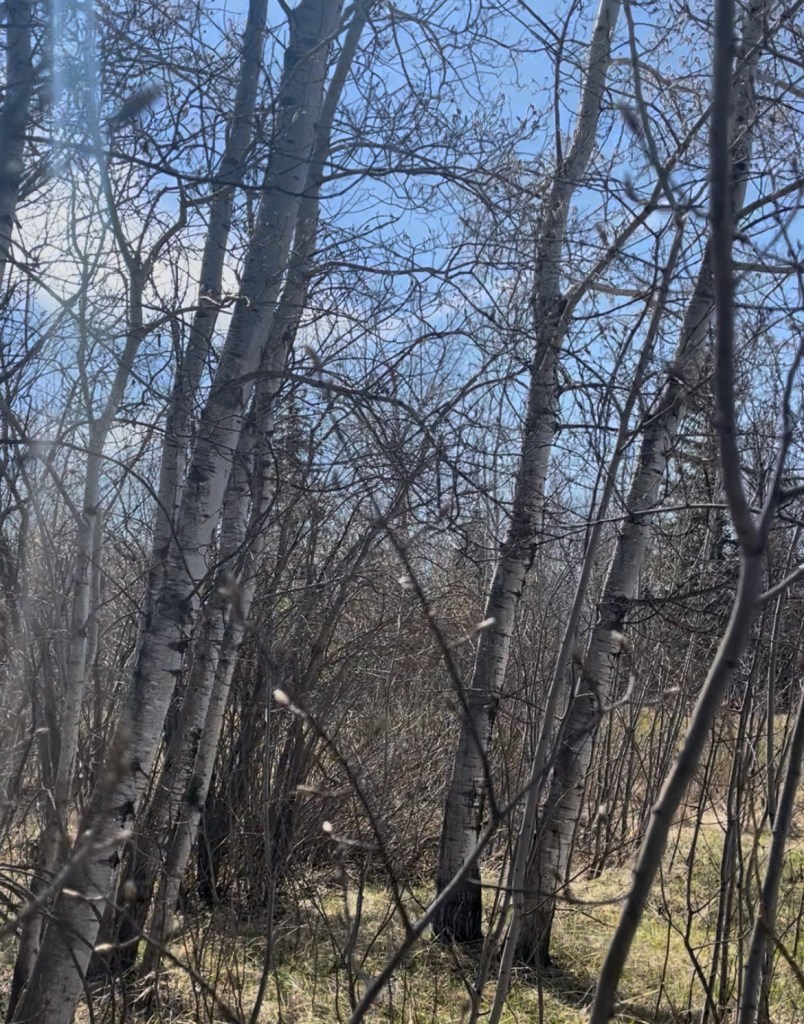
Everyone else seems to walk a wide, sunlit path: their maps are clear, their steps steady, their packs light.

Meanwhile, I carry heavy bundles of pain and medicine, stumbling often, wondering if I’ll ever catch up.

~Cue the tiny violins 🎻 🤭~

Beyond the Familiar: Embracing a Different Forest

My therapist keeps telling me to stop comparing myself to other people – that life’s not a competition. Which, to be fair, is exactly what I’d say to someone I was trying to beat, too.

-from 22 Quotes About Chronic Pain

Comparison is never useful. It’s like measuring trees by how tall they look in someone else’s forest, forgetting that soil, roots, storms, and sunlight differ wildly. 

Or like judging an oak tree by how quickly the wildflowers around it bloom. Different roots, different seasons, different reasons for being.

And yet I fall into it—measuring my path against someone else’s trail, forgetting we are not even walking in the same terrain.

Comparing … is a waste of time and effort; we are all different people, experiencing and feeling things differently.

San Diego Prepare Yourself: Sisterhood Adventures Await

Next month, my sisters will gather in San Diego. I am so excited for them. And to hear about their adventures. Sunshine, laughter, time to connect. It’ll be fabulous.

I would love to be there. But the cost of my monthly medicine is about the same as what that trip would take.

I live in a different economy—the economy of pain management. So instead of boarding a plane, I stay home.

~Poor lil’ me 🥲👉👈 🤣 ~

It’s hard not to compare. Their togetherness, my absence. Their momentum, my stillness. I remind myself that longing is not failure—but it still stings.

Screenshots of a Life I Don’t Live: Family Call, Personal Spiral

On a recent morning: my sister called from her vacation in London. On a family video call. At 9 a.m., I was still coaxing my muscles awake.

I listened to the bagpipes she was sharing and checked out the sights in the background. I marvelled at what she has been able to accomplish and see in her life. I joy in her success.

Inevitably another emotion starts to rise. As on the screen, this is what I see:

  • One sister in her home office, thriving in a job that suits her perfectly.
  • Another in her kitchen, caring for her family and home.
  • A sister-in-law outdoors, likely at the park or on a walk with her two littles.
  • My parents smiling in their living room, enjoying retirement and seeing their family.
  • And then there was me—tired, clearly still in bed, clearly accomplishing nothing.

That’s how I saw it. In truth, no one said that. But comparison painted me useless in bold letters across the screen.

~Woe is meee 🐌💤 😜 ~

A Sermon I Couldn’t Speak

At church, I tried to answer a question on a bad pain day after a sleepless night. My words came tangled, incomplete.

I saw my husband’s face and thought, I’m taking too long. I gave up. Without tying my random thoughts together. And I gave him the microphone. He expertly gave a clear, concise answer that was perfectly on point. My effort looked weak next to his polish.

Comparison whispered: why even try?

Fredrik Backman once wrote:

“My brain and I, we are not friends. My brain and I, we are classmates doing a group assignment called Life. And it’s not going great.”

But here’s the truth: trying counts. Even stumbling words are a kind of courage.

The Math of Measuring Up Never Works: The Broken Ruler I Keep Using

Comparison is a thief. It always leaves you with less than you started.

It’s like weighing a feather against a stone and expecting the scale to balance it out. It demands a sameness life never promised. It blinds us to the worth in our own story.

As a people, we tend to magnify the strengths and blessings another person receives. But minimize our own gifts, talents and opportunities. Social media is as helpful as a screen on a submarine when it comes to perpetuating this problem.

There’s no hierarchy of pain. Suffering shouldn’t be ranked, because pain is not a contest.

No one truly wins the “Pain Olympics”.

Lori Gottlieb

Living with chronic pain means my days will never look like someone else’s. But that doesn’t mean they’re lesser—it just means they’re different.

Brene Brown says:

Fear and scarcity trigger comparison and we start to rank our own suffering.

Brown calls this comparative suffering. She goes on to say,

The opposite of scarcity is not abundance; the opposite of scarcity is simply enough.

Empathy is not finite, and compassion is not a pizza with eight slices. When you practice empathy and compassion with someone, there is not less of these qualities to go around. There’s more. Love is the last thing we need to ration in this world

This toxic pattern of comparison blocks emotional processing and prevents genuine empathy, creating isolation rather than connection. 

My worth is not judged by what I do in comparison to others, but by what I do with what I have—what love, what compassion, what presence I can offer. Even just in showing up.

Measuring By Love, Not Ladders

I’ve decided to measure my life by something else: in every conversation, I want the other person to leave feeling better about themselves than when we started.

If they do, then I’ve accomplished something real. It may not be a promotion, a trip abroad, or a picture-perfect moment. But it’s love, and it’s within my reach.

In such a headspace there should be no time for shame and comparing. Only felicitations and adulation.

Broken But Still Moving
Mandy Harvey is a singer/ songwriter. I saw her on an America’s Got Talent clip. Mandy lost her hearing when she was 18. Interestingly enough she has EDS which is similar to my connective tissue disorder.

On the show, she spoke about initially going to dark places. And when she decided she wanted more for her life, she wrote this song. And performed it in front of a live audience and judges and cameras.

She beautifully sings,

“I don’t feel the way I used to / The sky is grey much more than it is blue / But I know one day I’ll get through/ And I’ll take my place again… So I will try…

There is no one for me to blame/ Cause I know the only thing in my way/ Is me…

I don’t live the way I want to/ That whole picture never came into view/ But I’m tired of getting used to/ The day

So I will try..

Those words hold me when comparison tries to unravel me.

Forest Therapy: A Way Forward

If comparison is a thorn, forest therapy can be a balm.

The forest floor is messy. Layers of leaf litter, moss, dead wood. It doesn’t pretend to be clean and perfect. It is rich because of its imperfections.

Your struggles, limitations, pain give richness and texture to your life story—not flaws to hide.

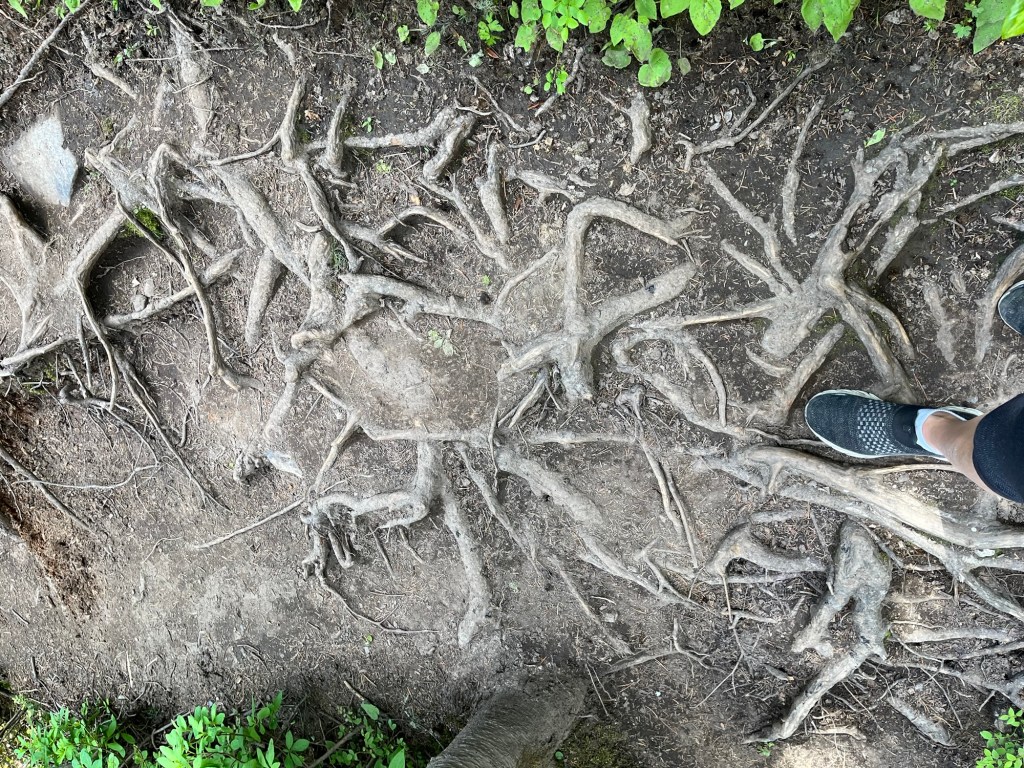
Walking a path in woods, you may have to step over roots, navigate mud and stray branches. But each step gives you awareness, grounding, breathing space.

Comparison often makes us spin like leaves in the wind; forest therapy anchors us.

When comparison grabs tight, I go to the woods.

The forest does not compare:

  • Trees don’t measure their height against one another.
  • Moss doesn’t resent the ferns.
  • Streams don’t ask why the river runs faster.

Each element grows where it is, as it is. That is enough.

Roots, Rituals and Small Resets

Here are ways the forest has supported me:

Leaning against a tree and letting its rootedness remind me that I, too, belong.

Listening to the birds until my thoughts soften.

Sitting by water and imagining my comparisons floating downstream.
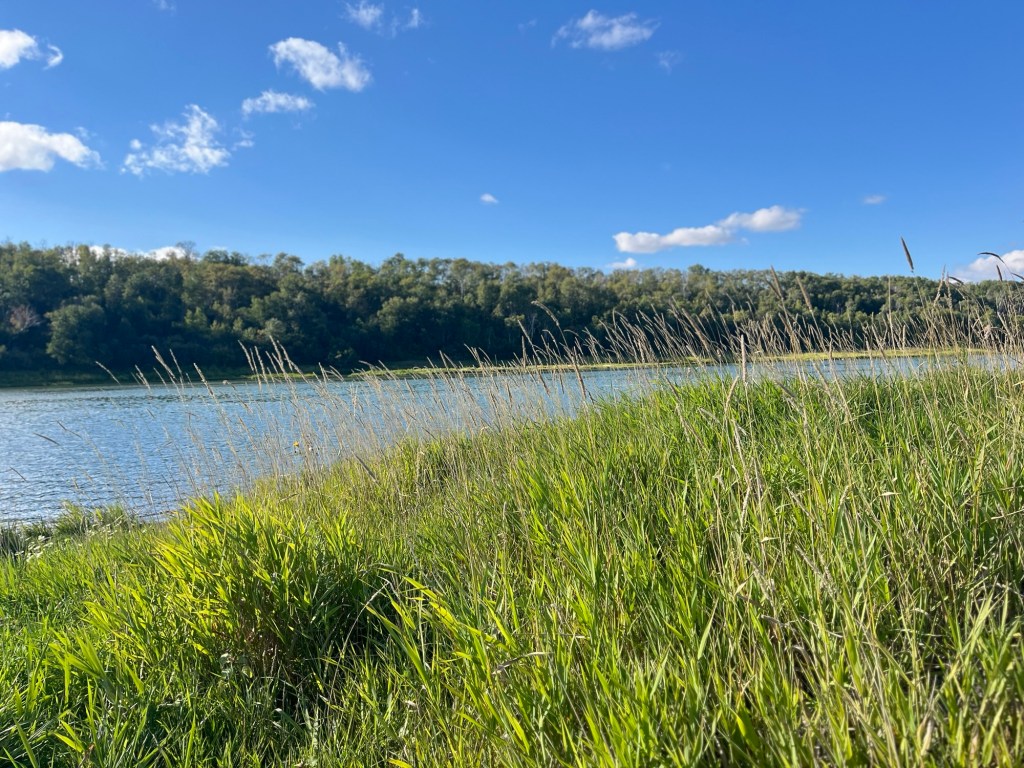
From Forest Floor to Open Sky

Yes, I still compare. Yes, it still hurts. But when I remember that comparison steals joy, I find space to choose something else.

I may not be in San Diego, or London, or even fully awake at 9 a.m. (to those who are, Have as good a time as possible, given that I’m not there. Heehee 😊)

~Life said nope 🙃🍋~

I can still offer kindness, presence, and love.

And maybe that is enough.

I want to feel good about my life. Not in the sense of “as good as anyone else,” but as my life, full of the shape I have.

Chronic pain is part of the soil I grow in. It’s changed what I can do, yes—but also deepened what I can feel, what I can appreciate.

If everyone else seems to be walking on sunlit paths, I may be walking in dappled shade, or in a different time of day. But my path is still mine, and still worthy. Because even in the shaded parts of the forest, light still filters through.
🍂Forest Therapy: A Refuge from the Battle of the Pill

If I stand on my tip toes I can see autumn from here.

-Unknown

There are nights when pain feels like a forest fire. It consumes everything, licking at nerves, muscles, and bones, until even the smallest ember becomes unbearable. For me, forest therapy has always been a refuge—trees that don’t ask me to explain, the wind that listens without judgment. But no walk in the woods can erase the reality of the deep harm that comes when the medications I rely on are suddenly out of reach.

Biophilia

the ancient memory that li ves in our bones- a quiet longing to belong to the earth, a deep and sacred bond that awakens our senses and nurtures our souls.

Tales from My Trek

Recently, I went to fill my prescription. It’s a narcotic, tightly controlled with a note that says it can only be filled every 30 days. The problem? It was day 29, and I was out. 😳

For some prescriptions, waiting until the next day is an inconvenience. But when you’re on a heavy narcotic at the highest dose, one missed pill isn’t just painful—it’s catastrophic.

That night without medication meant I wasn’t just “in pain.” It meant shaking, twitching, and detoxing against my will. For a medication I’d have to take in the morning!

I’ve missed this pill before. My body, already fragile, spiraled: my nervous system hijacked by fight-or-flight, my hormones in chaos, my temperature regulation broken. I’d overheat, then sweat, then shiver, round and round. All while my pain screamed louder and louder. It is my definition of Hell.

And the damage doesn’t end when the sun rises. One night like this unravels days—sometimes weeks—of careful work to bring my nervous system into alignment. Forest therapy sessions that usually soothe my body’s alarms are erased by the fresh trauma of unmanaged withdrawal.

One pill—just one—becomes the difference between fragile balance and collapse.

The Pharmacy Door 🚪

This wasn’t the first time.

Years ago, when I was short on medication, it was actually the pharmacy’s mistake. A tech who knew me—a kind soul who remembered my name—looked closer. While others repeated, “Sorry, you can’t have more. Come back tomorrow,” he dug into the records and discovered their count was off by the exact number I was missing. He trusted me. He believed my story. He saw me.

This time was different. My tech friend wasn’t there.

When this new tech told me I couldn’t have more until tomorrow, he must have seen the terror in my eyes. Or noticed me standing in shock for 5 minutes. Just standing by the pharmacy. Holding back tears, while physically and mentally spinning in circles. But instead of offering solutions, he shrugged and said, “Come back in the morning.”

Being someone who hates to cause a stir, I went home. But home is where the panic broke through. I sobbed uncontrollably. My body already gearing up for withdrawal.
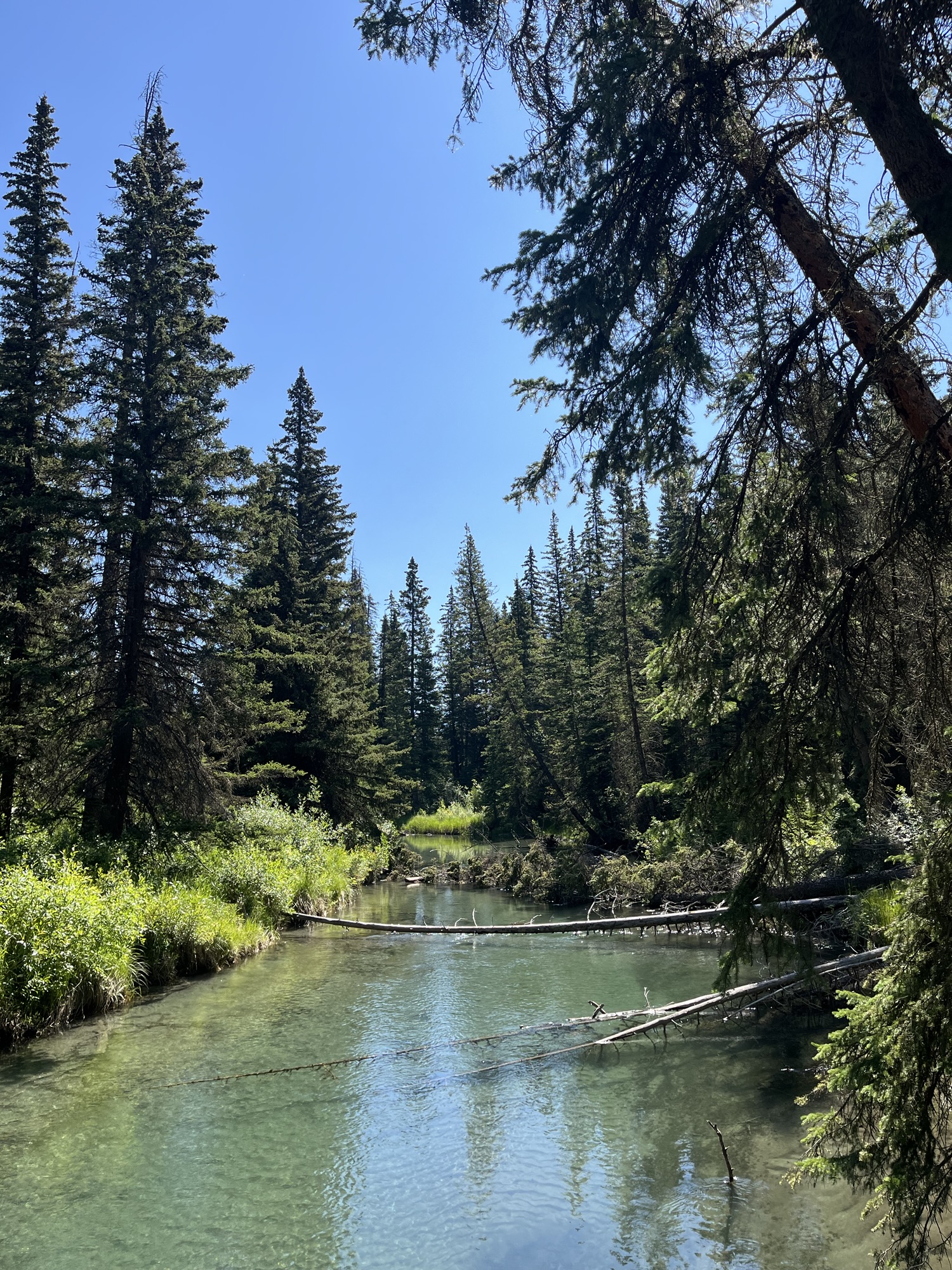
Then I realized: silence won’t help me survive this.

I called back. I asked about options. The tech said I could talk to the pharmacist. Why wasn’t that offered before? 🤨

When I spoke with the pharmacist, his tone was dismissive, almost mocking: “So what do you want me to do about it?”

I explained again, told him what would happen if I went without. He finally asked if I’d even come pick it up that night IF he were to fill it.

Sir, I thought, I just told you what a night without it would do. Do you think I’d let that happen if I had any choice?

Eventually, he relented and filled it twelve hours early. I picked it up feeling like I should bow at his feet in gratitude. As if he’d granted me a favor rather than spared me a night of needless suffering. I felt the need to thank him repeatedly.

The petty side of me still wants to send him a Get Better Soon card. Not because he’s sick. But because I think he could do better. As a human being. I’d have to send it anonymously because this is not a person I want to be on their bad side.

The Bigger Picture

I know narcotics require tight monitoring. I know the system has to guard against abuse. But what about patients like me—the ones who never asked for this, who were put on these medications by doctors, and who don’t have the option of just going off of them. When there is something physiologically happening that is not right.

If only I could put into understandable words. This is what is happening everywhere in my body. ☝🏼

Why does losing one pill make me look like a drug seeker? Why is my lived record of years not enough to earn trust? Why is the assumption always suspicion?

Do they want me to be all natural? Do they realize it is people like me who keep them in business? I literally pay their bills!

I wouldn’t have to if I could live every day in the forest—if I could soak in the mossy quiet, breathe in the pine air, let the gentle rhythm of birdsong reset my nervous system—perhaps I wouldn’t need the pills.

But my reality is different.

My reality is managing chronic pain in a system that too often treats me like the problem instead of the patient.

🍂 Whispers of the Woods

As I write this, I think of a line from poet Wendell Berry:

“The care of the Earth is our most ancient and most worthy, and after all our most pleasing responsibility. To cherish what remains of it and to foster its renewal is our only hope.”

What if the same was said of patients? To cherish them. To foster their renewal. To see them not as potential criminals but as human beings navigating unbearable pain.

Another lesser-known verse comes to mind from Antonio Machado:

“Between living and dreaming there is a third thing. Guess it.”

For me, that “third thing” is surviving. It’s clawing through nights without medication. It’s cobbling together therapies—like time in the forest—that offer some relief, though never enough.

Compassion: The Heartbeat of Humanity

I don’t have the solution. But I do know this: when we treat patients like addicts instead of people, we add more pain to lives already saturated with it. I believe we can find a way to monitor responsibly while also practicing compassion, dignity, and trust.

So I’m asking you: have you experienced something like this? Have you been caught in the impossible bind between regulations and your own survival? Do you have ideas for how this system could better serve those who truly need it?

Share your thoughts in the comments. Let’s start a conversation. Because one pill shouldn’t have the power to undo everything.

It was a lovely afternoon-such an afternoon as only September can produce when summer has stolen back for one day of dream and glamour.

-L.M. Montgomery

The Economy of Chronic Pain

I got saved by the beauty of the world.

-Mary Oliver

A dear friend once said something to me that I can’t get out of my head: chronic pain has its own economy. She suggested I write a post on it. So here we are. (@soulfullifebyamanda)

For anyone under the impression that disability payments and medications cover everything in chronic pain, this quote is for you.

Illusion is the dust the devil throws in the eyes of the foolish.

-Mina Antrim

For anyone suffering financially and energetically, let this post be your validation. And don’t worry. “Whatever doesn’t kill us only makes us weirder and harder to relate to.”

Does anyone else feel like their body’s ‘check engine’ light has been on for months and you’re still driving like, “it’ll be fiiiiine,” because you can’t afford to do anything about it anyway?

When I think of the economy of chronic pain. I picture myself stepping into the forest with only a small shopping basket. Every choice I make—financial or physical—has to fit inside that basket. There’s no room for waste, no luxury of tossing in extra. Just like in the forest, every twig, every step, every breath matters.

For those of us living with chronic pain, our baskets are small. They hold both our financial and our energy reserves—and both run out faster than a knife fight in a phone booth.

In Canada, disability payments exist, but they are like shafts of sunlight that barely break through a dense canopy. They aren’t enough to warm the forest floor.

And so, we ration. We stretch. We weigh every step carefully. And in the process provoke our fussy nerves into an outraged uproar over and over again.

Surviving the Price Tag

Here’s one example from my own life: every month, I spend about $600 on medication for pain relief. There’s no coverage for it. It’s outrageously expensive, but it’s what allows me to keep moving through the forest at all.

Others I know make different choices. Some decide not to medicate, and instead spend their limited resources on healthier food, therapy sessions, or simply keeping a roof overhead.

There is no right way. Each of us is navigating our own overgrown path, deciding what can fit in the basket we carry.

Even those of us diagnosed with chronic pain conditions may not see the myriad of options. Of what could go in the basket. Given the resources. More frustrating is the knowledge that some therapies, while proven extremely effective, will not be financially viable. In some cases, not even offered in my area.

  • counseling sessions; the cost coming out of pocket (no job=no benefits) is high, yet the benefits of CBT and ACT psychotherapy for pain have been shown to be impressive, marriage support is also much needed in the case of ongoing pain and illness
  • therapies; acupuncture, Reiki and other energy healing work, physiotherapy, massage, chiropractor, aqua therapy, hypnotherapy, the list can seem limited for your specific needs, but there are always new options coming available
  • medications; these are also ever evolving, I believe in a combination of medicine and natural therapies, this is a personal decision
  • lifestyle changes; Saskatchewan winters call for a gym pass to stay active, these are not free
  • dieticians; can support with ongoing needs
  • stress reduction therapies; FOREST THERAPY!!, meditation courses and classes, yoga, tai chi, music, art or pet therapy,
Spinkie- Den: Scottish; a woodland clearing filled with flowers.

The Grove of Dilemmas

When you live in this economy, everything has a cost. The pressure keeps me marvelously productive. I entered the kitchen to do the dishes, but saw the pile of laundry on the floor, so I watered a plant, while looking for my phone to make the doctor’s appointment. To sum up, I couldn’t find it in time and now my leg is swelling and I have to put it up again. I accomplished nothing. 😤

Given the choice, where are you willing to “pay” extra?

Do you get help with your home to attend to the piling dishes, laundry and dog hair, or put on blinders to the mess because there are no funds for such frivolity as clean dishes, clothes and floors?

“Any dog can be a guide dog if you don’t care where you’re going.”

Do you take the shorter trail to an appointment (closer parking) or save money by forcing your body down the longer route?

Do you use precious energy to cook a nourishing meal, or save your strength and spend more money on convenience?

Do you go out to meet a friend, knowing it will mean a day of recovery afterward, or do you stay home and bear the weight of loneliness?

The forest is full of paths, and each one demands a toll.

Costs That Lurk Beneath the Canopy

The cost of connection. Friendship and belonging are like wildflowers in the undergrowth. But they don’t bloom without effort. They often require money for transportation, or the strength to leave the house, or both. Yet the cost of isolation can feel heavier than any of it.

The cost of time. Chronic pain asks us to wait. Waiting for appointments. Waiting for medications to maybe work. Waiting for healing that never seems to come. Time here drips slowly, like water from moss after rain, and once it’s gone, it cannot be gathered again.

“The hardest thing about illness is that it teaches patience by stealing time.

-Unknown

Both remind me that even in this strange economy, even in this forest of loss and trade-offs, there is still gentleness. There is still strength in being here, still roots growing quietly beneath the soil.

Forest Therapy: A Rich Investment in Well-Being

And this is where forest therapy becomes not just a metaphor, but a lifeline.

When my basket is empty, when my reserves are gone, the forest offers a kind of wealth that doesn’t demand dollars or energy I don’t have. Sitting under the trees, breathing in the scent of pine, listening to the rustle of leaves—these are exchanges that give more than they take.

Forest therapy reminds me that not everything of value is bought or measured. The forest doesn’t charge for its healing. It simply offers. It allows us to rest, to breathe, to remember that even when our budgets—financial and energetic—are painfully small, there is still abundance to be found.

The economy of chronic pain is harsh and unrelenting. But the forest’s economy is different. It trades in stillness, in breath, in presence. It offers shade when the sun is too much, and quiet when the noise of survival is too loud.

This is why I keep returning to the trees. Because while the world asks me to spend what I don’t have, the forest reminds me: here, you are enough, just as you are.

The forest hides more than it reveals, yet what it reveals, sustains us.

-Unknown

The True Currency: Compassion

To those supporting people with chronic pain, we love you and we thank you. Please remember to lead with compassion. Your person is not lazy or careless, but living within an economy most cannot imagine. Lead with compassion and the way forward can be made clear.

We do not see nature with our eyes, but with our understandings and our hearts.

-William Hazlitt

To recap, I caution against developing chronic pain and illness. It is terribly expensive and inconvenient for others. 😏

September you are promising. The beginning of a gorgeous and necessary decay. The edge of triumph before the deep rest.

-Victoria Erickson

Minor Injury and Connective Tissue Disorder: Cue My Prison Sentence

To tell me I cannot run is to hold my body in contempt.

-Friedrich Nietzsche

This past weekend I was out boating with friends. The sun was shining, laughter was everywhere, and the water was perfect. My absolute favorite kind of day. Until it wasn’t.

The beach is so amazing. We all lay around in our undies with complete strangers eating sandy sandwiches and chips. What a world!

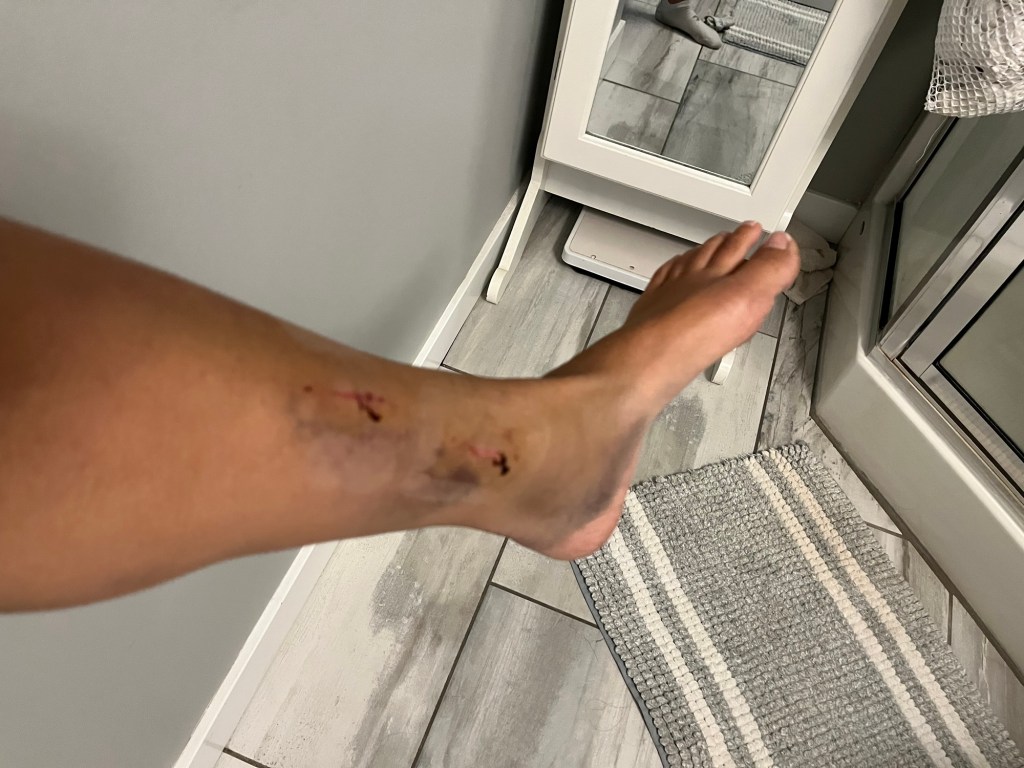
But this trip was too eventful for me. I slipped off the back of the boat. A simple misstep—my foot chose the slippy part before the ladder instead of the grippy part. My skin slid down the metal and scraped in a couple of places. For most people, it would be a painful annoyance. Maybe a couple of Band-Aids and an “ouch” when the rubbing alcohol stings.

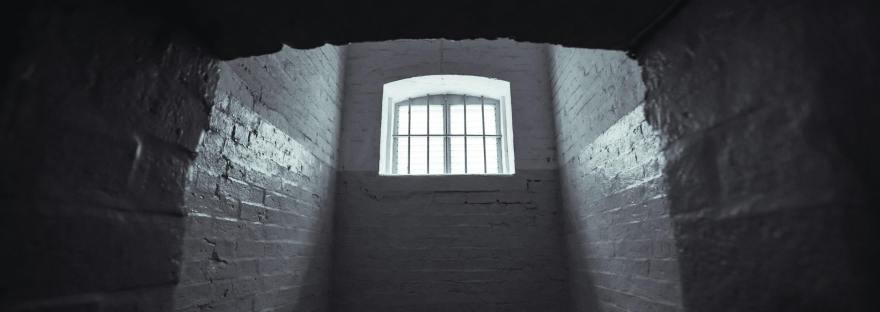
But for me, with a connective tissue disorder, a “minor” injury isn’t minor. It’s my own prison sentence.

Day 3 post slip

The moment my leg hit and the skin tore, my body responded like a toddler throwing a tantrum. Two points, swelling to the size of small eggs appeared instantly. My vision swam, nausea hit, and I nearly fainted. I had to be rushed off the beach. Reluctantly, I might add. I just wanted to stay and play. 🤷‍♀️

And yet, as I moved it around, the swelling went down. After a few ginger steps, walking proved feasible. So, I stayed on the beach. Carefully. Pretending things were fine. Until the next day, when I accidentally touched one of the angry spots and nearly fainted again from the pain. Cue swelling, round two.

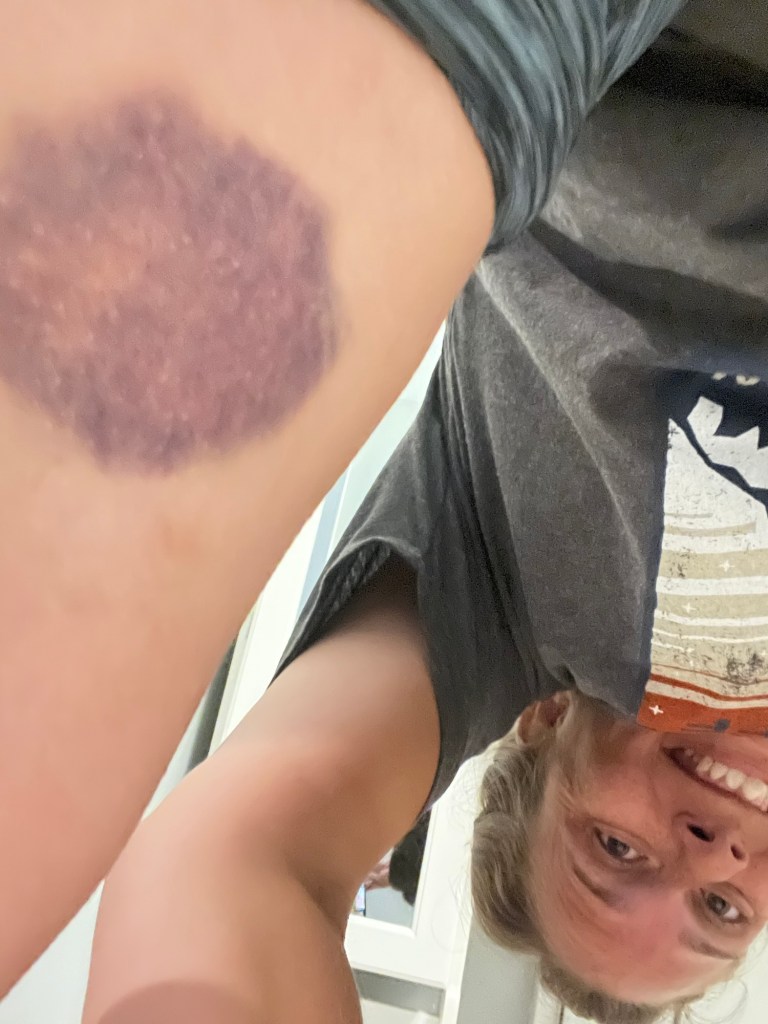
This bruise on the back of my leg also happened in the fall.

Nothing feels broken. This isn’t a cast-and-crutches type of injury. This is a – my tissue is angry and having a meltdown kind of injury. The kind that will ripple through every layer of healing, slowly, stubbornly, piece by piece.

The Cascading Consequence

Here’s what happens with mobile joints and connective tissue disorders:

  • Immediate tantrum. Tissue swells, pain spikes, body goes into shock.
  • Muscle aftermath. Even if the muscle wasn’t directly injured, it’s recruited in the act of catching yourself, and now it’s tight, inflamed, and waiting its turn to protest.
  • The balancing act. I need to keep running to maintain the strength that keeps my joints in place, but I also can’t overwork what’s injured.
  • Scar tissue sneak attack. When scar tissue forms, it doesn’t just “heal.” It tugs on joints already prone to slipping, pulling them out of place.

This 👆is why what looks minor to you becomes a long-term balancing act ⚖️ for me.

There is no test, no monitor, no scan that can tell us exactly what’s happening.

It’s me, listening to my body.

And my physiotherapist J, patiently piecing me back together one session at a time.

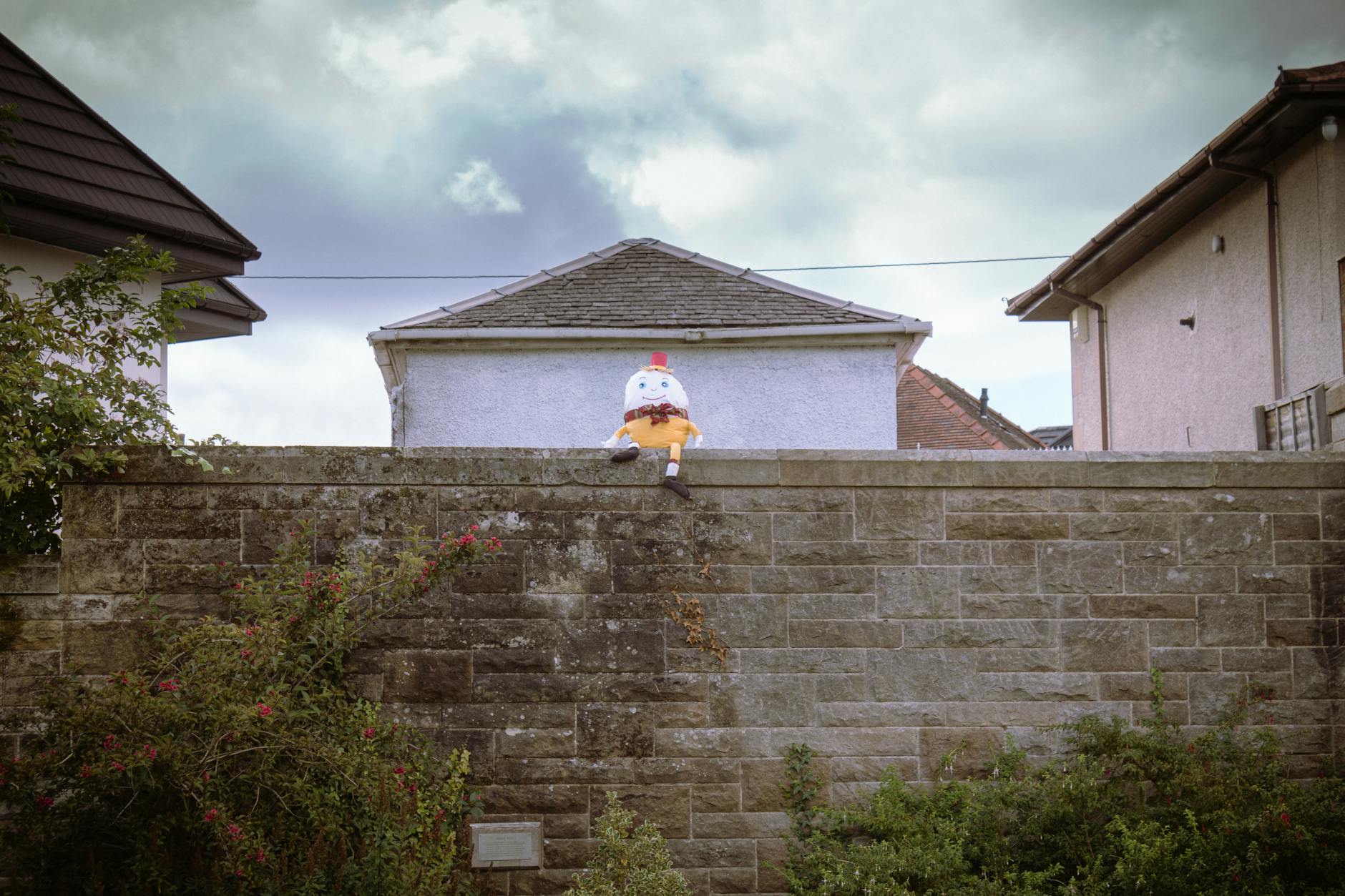
Photo by Mohamad Salam on Pexels.com

👆🏼 Me as Humpty Dumpty right before needing to be put back together again. 👆🏼

What most people heal from in days, I will heal from in months. 🗓

K️oekentroost

Dutch. “the emotional support cookie you eat after a mildly inconvenient day. (in my case it will be pretzels dipped in nutella)

The Weight of Waiting

The hardest part isn’t the pain. It’s the waiting.

Waiting to run.

Waiting to trust my joints again.

Waiting to see what the scar tissue will do this time to wreak havoc.

It feels like all the work I’ve put in at the gym—months of biking, running, strengthening—could slip away in the span of a single misstep.

That’s the prison. The confinement. The pause button ⏸️ on a life I’ve fought so hard to keep moving ▶️ .

Forest as Healer

But here’s where I return to what always saves me: the forest.

When I step (or hobble) into the trees, I remember that healing doesn’t always look like forward motion. Sometimes it looks like stillness. A dense canopy could be covering spectacular growth. The river’s gentle flow might be a glimpse of the heavy current below. The trees stand, patient and unwavering, reminding me that growth and repair take the time they take.

Forest therapy gives me what no physiotherapy session can: the intuition to hear what my body is really saying.

My blessing in life is to have a physiotherapist that encourages me to spend time there. And to follow my body’s intuitive pace and direction. J pursues us and provides support along the way.

It’s in the quiet green spaces 🌲 where I learn when to push 😖 and when to rest 💤 . Where I can breathe out the frustration 😮‍💨 and breathe in the steadiness of the earth 🌍 beneath me.

It is in the forest where I believe that healing isn’t just possible—it’s already happening.

When you read the list of benefits, do you see the connection? Grounding will be one of my greatest therapies in each phase of mending.

Words to Carry Me

“Adopt the pace of nature: her secret is patience.” — Ralph Waldo Emerson

“And let us not be weary in well doing; for in due season we shall reap, if we faint not.” – Galatians 6:9 

“The trees that are slow to grow bear the best fruit.” – Moliere

“Even the strongest storms don’t last forever. The sun always returns to the forest.” – Unknown

And she will keep coming back to life, over and over again, because beneath the skin of this gentle human lives a warrior unstoppable.

-Annabelle M Ramos

Healing with mobile joints is a marathon made of tiny sprints and long pauses. It’s the art of balancing strength with surrender. And when the world feels like it’s closing in—when a scraped leg feels like a prison sentence—the forest opens its arms and says, you are safe here. Take your time. Heal.

My veins are filled with stories of survival.

– Mitali P.

The Web We Weave: Fascia, Feelings, and Foliage

Feelings buried alive never die; they find a home in the body until we listen.

-Unknown

If you’ve ever pulled a loose thread on a sweater only to watch the whole thing unravel. You already understand fascia. Fascia is like your body’s built-in spider web. A stretchy, connective tissue that wraps around muscles, organs, nerves, and just about everything else. It’s the silent scaffolding that keeps you upright, and it’s a lot more sensitive than we give it credit for.

Now here’s the kicker: fascia doesn’t just hold tension from that yoga pose you attempted last week. It also holds emotions.

My fascia, for instance, is on the loose side. Because it is connective tissue. And I have issues in my tissues with my hypermobility condition. Yet, when I experience a shock or embarrassment, I will tense and hold. Until I have the chance to talk it out. Move it out. And let it out.

Stress, grief, fear, anger — if we don’t face them, fascia faithfully stores them for later. Think of it as your body’s junk drawer. The trouble is, the drawer isn’t bottomless. Eventually, it overflows, and the result is often chronic pain and stiffness. Or that “my whole body feels like a knotted shoelace” sensation.

When you are already a chronic pain sufferer, tension aggravates everything internally. That junk drawer is already pretty full at the start of every day. Your drawer has a tendency to overflow easily. Perhaps going into panic mode at the thought of being late for a wedding.

Fascia Unveiled (not literally, that would be horrific): A Closer Look (figuratively speaking)

Fascia tension and pain can result in the following symptoms:

  1. Fatigue that rests don’t fix
  2. A body that feels stuck or heavy
  3. Swelling or puffiness
  4. Aches that migrate
  5. Mood swings or emotional reactivity
  6. Brain fog or sensory overload

The Tapestry of Emotion

We are not separate threads, but one woven fabric. What happens to one part, happens to the whole.

-Rumi (paraphrased)

Picture a spider web in the forest. If you tap one corner, the whole thing shivers. Fascia works the same way. Tug on one tight spot. Say, your jaw that clenches every time you swallow your frustration. And the ripple travels to your shoulders, hips, or lower back. Over time, the whole web becomes taut, rigid, and reactive.

This is why chronic pain can feel so widespread and mysterious. It’s not “all in your head.” It’s all in your web.🙄

This web is intricate, adaptive, and intelligent. It is a continuous communication network. It adapts and evolves with every experience. It is shaped by your posture, stress, trauma and time.

And here’s the hard truth: loosening fascia isn’t just about stretching or foam rolling. It’s about facing the emotions strung up in that web. Otherwise, we’re just untangling knots that will retie themselves the next time life throws us a curve ball.

Foliage, Fascia, and Feelings

The trees are patient teachers. In their stillness, we remember how to soften.

-Adapted Forest Therapy reflection

So where does healing begin? Here’s a hint: it’s not in fluorescent-lit clinics with “soothing” elevator music.

Healing begins in places where the nervous system can finally exhale. Enter forest therapy. When you step into the woods, your fascia (and your frazzled nerves) start to soften. The forest isn’t asking you to perform, to prove, or to pretend. Trees don’t care if you’re angry, grieving, or stuck in freeze mode. They simply stand — tall, patient, rooted — and invite you to do the same.

The slow rhythm of nature helps coax tight fascia into release. Walking barefoot on moss and breathing in pine. Or even sitting quietly and noticing the way light filters through leaves sending signals of safety to your nervous system. Safety is the permission slip fascia needs to unclench and let go of the emotions it’s been storing.

Winding Paths to Wellness: Step by Step

  1. Notice the web – Pay attention to where your body feels tight when certain emotions rise. Jaw with anger? Chest with grief? Shoulders with anxiety? Naming the connection is powerful.
  2. Breathe with the trees – Try forest bathing. Experiment by simply sitting outdoors and syncing your breath with the sway of branches. Slow breathing calms nerves and softens fascia.
  3. Move gently – Instead of punishing workouts, try slow walking in nature. Gentle, mindful movement gives fascia the message that it’s safe to release.
  4. Feel it to free it – Allow emotions to surface without judgment. Cry, sigh, journal, or even growl (the forest can handle it). What your body expresses, it no longer has to store.

Tears are the silent language of grief.

-Voltaire

Other forms of therapy to release fascia include: Myofascial massage. Cupping. Deep stretching. Breathwork. Cold bath. Tread carefully. Some of these therapies will be too much for a toxic ridden body.

An Enticing Proposal

Your fascia is your lifelong spider web. When it’s tangled with old emotions, the whole structure strains. But the good news is this: just as webs can be rebuilt, so can you. Step into the forest. Breathe. Listen. Move slowly. Let your body know it is safe to soften.

Healing isn’t about forcing the web to untangle. It’s about giving it the stillness, compassion, and space it needs to find balance again.

Healing begins when we allow the heart to speak and the body to answer.

-Adapted wisdom

CBT & Chronic Pain: Finding My Way Back to the Forest

“Just because you think something, doesn’t make it true.”

-unknown

Today we are talking CBT. Not CBD (that’s a whole other post) But CBT. Which sounds fancy, but it’s really just brain training.

Cognitive Behavioural Therapy is about noticing the sneaky little thoughts that creep in when life feels unlivable, and learning how to shift them just enough that you don’t get engulfed by it all. CBT is brain training for when your nervous system starts acting like a toddler in a toy aisle. Hyperactive. Impulsive. Emotional outbursts and mood swings. On high alert. Where self regulation becomes difficult.

It doesn’t erase pain (I wish). It doesn’t rebuild the life you’d planned (double wish). But it does help you find a new footing.

Kind of like wandering a forest trail—where you keep tripping on roots you didn’t see, but then you realize… if you slow down, if you watch your step, if you breathe—it’s possible to keep walking.

img_5990

As Viktor Frankl once wrote:

“When we are no longer able to change a situation, we are challenged to change ourselves.”

That’s CBT. Not fixing the forest. Just learning how to move through it differently.

Kind of like the friend who kindly takes away your “end of the world” glasses and swaps them out for “yeah, it still sucks, but you’ve got this” glasses.

Here’s the deal: chronic pain is not just pain. It’s also the grief of losing the version of life I had sketched out in neon colours.

A Preposterous Odyssey: Tales from My Crooked Journey

When pain became my daily companion, I felt like someone had dropped me in a wilderness without a map.

I wanted my old trail—the one I’d carefully planned and marked. Instead, I found myself in dense undergrowth. Nothing looked familiar. Every step hurt.

I’ve missed family trips. Suddenly ended a business my mom built up and passed on to me. Letting go of what it has taken my whole life to build has been heartbreaking.

I have grieved hard. The life I wanted felt like a house I’d just finished building, suddenly bulldozed overnight.

But in CBT, I started to learn that maybe I didn’t need to rebuild that house right away. Maybe I could step outside, find a patch of ground, and plant something small.

The forest became my classroom.

A tree doesn’t “should” itself taller. It just grows where it can. A broken branch still belongs to the tree. Roots tangled around rocks still dig deep.

And I thought—maybe I can live like that too.

img_6893

What CBT Looks Like in the Wild

Here’s how CBT shows up when I walk among the trees with pain and grief:

• Catch the catastrophes. In my head: “This pain will swallow me whole.” In the forest it is as the African proverb says, “the wind howls, the trees bend, and yet they do not break.” I remind myself—I can bend too.

• Challenge the “shoulds.” I see seedlings pushing up through moss. They don’t say, “I should be a tall cedar by now.” They just keep growing. Maybe I can let myself do the same.

• Make room for both grief and joy. The forest holds both fallen logs and wildflowers. My life can hold both too.

CBT is not about denying the ache. It’s about learning to see yourself in a bigger landscape—where pain isn’t the only thing growing.

CBT is not about putting a smiley face sticker on a grenade. Instead, it teaches you to make room for the hard stuff—the grief, the frustration, the “I want to throw my heating pad across the room” rage—without letting it bulldoze your entire sense of self.

Walking With Grief

Grief still ambushes me. It stings when I see friends excelling in their careers and I can’t work. But the forest has taught me: standing still while others are moving is part of my journey.

When I sit against a tree trunk, I feel its strength. I remember that even a tree scarred by disease provides shade. I don’t have to be who I was before. I just have to keep breathing through the life I have now.

As poet John O’Donohue said:

“May you recognize in your life the presence, power, and light of your soul. May you realize that you are never alone, that your soul in its brightness and belonging connects you intimately with the rhythm of the universe. “

In the forest, I remember I still belong. Pain or not. Loss or not.

The Buddha (who knew a thing or two about suffering) said:

“Pain is certain. Suffering is optional.”

The Grief Side of It

CBT also helps when you’re sitting in the grief of the “life you planned.”

When you feel small and useless. When you scroll past everyone’s travel selfies and feel like the human equivalent of a potato.

Instead of spiraling, CBT teaches:

• Notice the thought: “I’m worthless now.”

• Question it: “Would I say that to my best friend in this situation?

• Replace it with something compassionate: “I’m in pain, but I’m still me. And I still matter.

CBT doesn’t take away grief. But it helps you walk with it instead of being dragged behind it.

As Mary Oliver wrote:

“Someone I loved once gave me a box full of darkness. It took me years to understand that this, too, was a gift.”

I don’t know if chronic pain is a “gift” (feels more like a re-gifted fruitcake). But CBT helps me carry the box without dropping it on my toes. And exacerbating the pain.

The Bittersweet Nature of Truth

Managing pain you can’t control is brutal. There’s no sugarcoating it. But CBT gives us a fighting chance to stop our thoughts from adding gasoline to the fire.

It’s like teaching your brain to stop shouting “THE HOUSE IS BURNING” when really, the toaster just sparked again.

So here’s to adjusting sails. To finding laughter in the ridiculous moments. To grieving the life we planned, while still living the one we have—beautiful, messy, painful, ridiculous.

Because if we can’t cure it, we can at least outwit it.

“Life is 10% what happens to you and 90% how you react to it.”

-Charles R. Swindoll

From Suffering to Sturdy: A Journey Forward

Chronic pain that cannot be treated or controlled is brutal. There’s no pretending otherwise. But CBT helps me stop setting up camp in despair. It gives me tools to step back onto the trail—even if I’m limping, even if I only make it a few steps.

And the forest gives me a place to practice.

It whispers: adjust your sails, bend with the wind, let the light through where you can.

So I keep walking. Slowly. Laughing when I have to contort my body to get some joints back in place. Crying sometimes too.

But still walking.

“Between every two pines is a doorway to a new world.”

– John Muir

Healing Chronic Pain: The Fight, Flight, Freeze, and Fawn Response

The body keeps the score, the body always remembers.

Bessel van der Kolk

Chronic pain has been one of my greatest teachers. Not because I wanted the lessons. But because it refused to allow me to skip class.

I grew up hearing the terms fight or flight. It was always in the context of trauma. I learned about freeze and fawn in more recent years.

IF you are unfamiliar with these states. Blow this up ☝🏼 and take a glance, get a feel for how these patterns operate for the general public.

I was surprised to learn that these patterns are all operating in my life. Likely due to my chronic pain.

The body that keeps moving isn’t driven- it’s bracing. A survival pattern disguised as productivity. A nervous system trying to stay one step ahead of collapse.

-@emberunbound

I didn’t realize that chronic pain could push my nervous system into these same states. And keep me there for long stretches of time.

Our bodies are wired to protect us from danger. But what happens when the danger isn’t the tiger in the bushes… but a pain flare that never truly ends?

Pain is supposed to be the warning that something is wrong. Literally life threatening. But with chronic pain every movement. Every situation. Every experience. Gets imprinted incorrectly. And experienced in the mind as life threatening. We’re not supposed to be exposed to this type of danger all the time. When the alarm bells keep ringing. How does one keep from going berserk?

Your Body’s Ancient Alarm System

The body has 7 trillion nerves and some people manage to get on every last one of them.

When the nervous system senses threat- whether physical, emotional, or imagined- it flips into protection mode.

  • Fight- “I have to push through this pain, no matter what.” “I feel irritated by everything.”
  • Flight- “I have to escape this situation (or this body).” “Nobody understands, I should just leave.”
  • Freeze- “I can’t do anything, so I’ll shut down.” “I can’t handle anymore right now.”
  • Fawn- “If I just keep everyone happy, I’ll be safe.” “I wish I could go home to rest, but I need to stay so they don’t feel bad.”

With chronic pain, these responses aren’t always dramatic. They can be quiet, creeping patterns that take root in daily life.

Once triggered, we find any input is too much. Noise. Lights. Crowds. Smells. Chaos. Multiple things competing for our attention. This sensory overload can start to make us feel panicky, confused, and overwhelmed.

I suggest this is because we live at the height of what we can handle. Just with our pain. Adding anything easily takes us to a breaking point.

How Fight Shows Up in Chronic Pain

She thought strength 
was measured in miles run,
lists checked,
burdens carried alone.
Then she learned
that strength can also be
in saying "enough."

For me, “fight” often looks like overdoing it. I grit my teeth, force my way through the task, and pretend the pain isn’t there. I know I’m past my limit when I start getting on my own nerves.

She was fierce, but her body was tired. She was determined, but her cells were weary. And yet, she still rose.

-Unknown

Flight: The Urge to Escape

She packed her bags 
for the hundredth time,
not always with clothes-
sometimes just with dreams.
But the horizon
was only another room
she carried inside.

Sometimes the pain feels unbearable, and all I want is to run- from conversations, commitments, or even my own thoughts. With chronic pain, “flight” doesn’t always mean sprinting down the road. It can mean numbing with endless scrolling, binge-watching, or mentally checking out.

Some journeys take us far from home. Some adventures lead us to our soul.

-C.S. Lewis

Freeze: Stuck in Place

When pain is constant, your nervous system never gets the memo that the war is over.

Dr. Howard Schubiner

Freeze is tricky. It feels like exhaustion, procrastination, or brain fog. It is not laziness- it’s biology. The nervous system has decided the safest thing to do is… nothing.

Chronic pain can hold the body hostage, and freeze mode locks the mind in the same room.

Fawn: People Pleasing for Safety

If you avoid conflict to keep the peace, you start a war inside yourself.

Cheryl Richardson

This one surprised me the most. And yet, it makes so much sense. Fawn shows up when I ignore my own limits to keep others happy. Agreeing to help when I’m in pain, smiling through a flare so no one feels uncomfortable. It can keep us “safe” socially, but it costs us our healing.

Why This Matters for Chronic Pain

When our bodies stay in constant fight- flight- freeze- fawn cycles, our pain often increases. Muscles stay tense. Sleep gets disrupted. Digestion slows. The immune system struggles.

She said "yes
so no one else
would have to feel
her "no."
But the body keeps
its own calendar,
and it circled today
for the breaking point.

-Misty Bernall

Recognizing the pattern is the first step toward calming it.

Seatherny

(noun) the serenity one feels when listening to the chirping of birds

Calming the Nervous System

Here’s some ways I’ve found helpful to calm an overactive nervous system.

  • Slow breathing- inhale for 4, hold for 4, exhale for 6
  • Gentle self talk- “My body is doing its best to keep me safe.”
  • Micro- rests- lying down for 5 minutes before I truly need to
  • Safe connection- calling someone who understands without judgment
  • Crying- releases pent up emotions
  • Chug water- a natural way to detox physically
  • Run hands under cold water- to trick the brain into distraction
  • Nature time, a brisk walk- or take some time for forest therapy
May the tide wash away your fear
May the salt air clear your thoughts
May you feel the pull of the moon
reminding you to rise and rest in turn
May your heart find its steady beat,
and your body remember-
you are safe to float now
-Lucille Clifton

Mending While the Alarm Still Rings

The nervous system can be rewired, but it’s a slow mending- like stitching a beloved quilt by hand. Each breath, each choice to rest, each moment of kindness toward ourselves is a new thread.

May the trees stand guard over your rest
May the wind carry away your pain
May the earth hold you steady
and the roots remind you-
you belong here
May the path ahead be soft underfoot
and the light always find your face

I am learning not to be mad at my nervous system. It’s trying to protect me the best way it knows. I can thank it for its service… and then gently let it know I am safe now.

A Blessing for Your Journey

May your heart rate slow
May your shoulders drop
May your jaw unclench
May the river of your breath
remind you of the ocean's rhythm
May you remember-
you are safe, you are whole, you are here

Chronic pain is impressive, but so are you. In the best way. Solid. Grounded. A force to be reckoned with.

An All-Too-Familiar Tale in Misdiagnosed/ Underdiagnosed Female Chronic Pain: This Is My Story

In today’s post I’ll be sharing more about my joint hypermobility diagnosis journey. Due to brain fog and the length of time this went on, my chronological ability is a tad sketchy. Regardless, the emotions and the pain of my story are real.

I hope you can’t relate to my story. But I’d love to hear from those of you who have also experienced a diagnosis nightmare. Particularly those with hypermobility.

From Spark to Flame

In the spring of 2011 I was tired of the sharp pain in my left armpit. It had been happening on and off for years. I didn’t have the brain power or the time to deal with it. I had three little kids instead.

That year I planned on going back to work as an EA. My kids were school-aged. And I was going to take the EA course that fall. Being on my feet more often without the ability to rest when I needed was a game changer. But not in a good way. Sitting in a chair for 6 hours a day for school was brutal.

The Beginning of a Beautiful, Medically-Invoked, Friendship

I started seeing a physiotherapist. She was heralded as one of the best diagnosticians of joint and muscle pain in town.

I will be forever grateful for the referral that sent my brother to see her after his knee injury. Which led to a referral from my mom that I should see her.

She has been with me from that time. She has saved my life in more ways and more times than I can count. She is my superhero.

From our beginnings, J walked by me through the process of navigating the medical field. With chronic pain. As we became friends and she learned about me and my family, she also became a trusted counselor. As she saw me opening to other forms of therapy, she shared her knowledge of energy therapy. When she learned my kids all have ADHD like their dad. She gave me hope and help on that subject too!

In her role as a physiotherapist, if she’d had the authority to order tests. I believe my diagnosis journey would have been completely different. But that is neither here nor there. Because I did not have access to a comprehensive team of doctors. I was the one running between and trying to pass on messages. I got them mixed up or had incomplete information. The doctors didn’t seem to care what J had to suggest.

So while J kept putting me back together and giving me exercises, the doctors kept telling me I was fine.

Doctors: Just work with a physiotherapist. It’s not a medical issue.

On the other hand, I would sneeze and feel something rip and go cold in my left shoulder blade area. I’d go see J and she’d fix me.

I’d wipe a counter and the same sensation. Back to J. She suggested something deeper was happening. (of course all she can do is find the spots that need fixing and fix them. She can only work with the effects something is having on the joints. She cannot see or fix the joint itself. Only its placement in the body,)

Coldplay Has Got Nothing on my J: She Will Try To Fix Me

I’d fight with doctors to give me an ultrasound. I’d experience deep pain in the exam as they shoved the paddle into my abdomen and groin. Often trying to locate missing organs. They always showed up eventually.

***TEST RESULT NORMAL***

Chiropractors.

***DIAGNOSIS: you’re out in a few spots. *crack*

Me: (walking out the door and looking down to step over the ledge)*crickety crack crack pop*

I’d go back to the doctor. Same procedure every time. They’d want to know where the pain was coming from. (everywhere) They’d ask how the pain felt. (depended on the day) They’d ask what made the pain worse. (being mobile, living my life) They’d want to know what made it better. (laying down, not moving)

“Well Pam, you can’t lay on the couch and expect to get better” (actual comment from an actual doctor that had a quick chat with me over the phone, I thanked him)

Me: Thank you. Good day.

Doctor: There might be something I can do, just don’t get your hopes up.

Me: I said Good Day

(maybe not those words but that was the tone)

This was always hard to hear. I had been running and working out before the pain got unbearable. And then I’d try again. J would ask when the pain started. (the day after I tried to jog. I just lifted 5 lbs a few times and then a few more the next day, etc.) I’d flare. My joints would be less stable. Back to J. She was always so kind and just put me back together.

I wanted nothing more than to run and workout. The doctors would have me move this way and that. Lift this arm. Touch the floor and come back up. Any pain? Now? Now? (nil, the pain would surface the next day though, and it would bring reinforcements.) But the appointment was over and the doctor wasn’t there to see that happening. So it wasn’t in the charts.

I don’t know what my doctors wrote. But due to no further investigation, I am led to believe it was something like the following.

***DIAGNOSIS: Kinesiophobia (fear of movement)/ Agoraphobia (fear of open situations: due to potential for unexpected pain and inability to attend to it)***

Back to J. She would put back all the spots that the doctors had unwittingly subluxed with the tests. J looked at the pattern.

***diagnosis: extreme hyper mobile joints*** but this was not a diagnosis the doctors wrote down or understood

Diary of A Misunderstood Patient: “I Tried to Tell Them”

I don’t blame the medical professionals in the beginning. But as the situation went on and I tried to tell them how this would go.

“I will do the tests. It will not cause me pain now. Because I have extremely mobile joints. And tomorrow due to shifting and stretching those joints outside their comfort zone, they will sublux. The pain is not in that shift. The pain is from the muscles that are left to hold that spot together. Now that the joint is no longer capable of doing its job. That muscle will get more and more sore as it holds and holds anytime I am mobile. It will eventually give out. Another muscle will get involved. And so on down the line. While this is happening this joint will have more stress on it. Initially just the joints around the unstable one. But eventually leading to my main muscles and joints. It will cause great pain.”

Doctor: OK, so you can do the test?

Me: (blink, blink) Yes

Doctor: If I don’t do this test, I can’t diagnose you.

This became the answer from specialists I waited months to see. I couldn’t give up the chance for answers. So I would do the test.

***DIAGNOSIS: NORMAL***

***TEST RESULTS for their specific specialty: NORMAL***

Back to J. She would inquire how things were going as far as tests and treatments from the medical side. I saw pain in her eyes as she saw the misery and agony I was going through. In this process. And physically.

It was draining the life out of me. J was always careful not to complain. She would never say anything unkind or unhelpful with reference to doctors or their way of doing things. It was as though she had been there herself. And was at peace with it.

The Final Act: With Room For Improvement

During my “end-of-the-line-of-specialists” appointment with a rheumatologist I broke down. I sobbed to her. Something was wrong and nobody could find it. Everything was coming back normal. She said it had nothing to do with her specialty. But she would send in a request for an MRI.

I wanted this test to show something so bad. It seemed like such an odd thing to hope for. To be diagnosed.

I had the MRI. I waited to hear back from my family doctor. She said they found a tiny bone spur. In my shoulder blade region. It was creating inflammation in the tissue and everything else in the area. Every. Time. I. Moved.

***DIAGNOSIS: bone spur***

I felt validated. Finally! Someone saw something! My pain was real!

I waited to see a shoulder surgeon. He told me my bone spur was so small they normally wouldn’t operate on it. But I did have a small area for it to fit. So if I wanted they would do surgery. Um yess please. Please fix me.

***TREATMENT: surgery to remove “tiny” bone spur***

I waited more months to hear when the surgery would be. Then I waited months for the actual day.

I should mention that through this time I was also diagnosed with endometriosis and its ensuing pain and surgery. Every couple of years they went in to scrape out the scar tissue. And put my organs back where they were supposed to be. I was having more and more trouble recovering from surgery. The internal inflammation was crazy.

The Road To Being Un-Recovered

After my shoulder surgery I was so relieved to have that nasty scoundrel out of there.

But the recovery from this surgery was particularly difficult. The years of waiting for the next specialist. The next test. The next referral. Had worn down my body. Months of lying down whenever the opportunity presented itself at the end of a workday. The end of putting kids to bed. The end of the cleaning and laundry. It always had to wait. But the lying down instead of working out were creating more tell-tale signs that something was wrong.

After this surgery. My mouth had a pesky sore on it from the breathing tube pressing my lip between it and my teeth. Making it hard to eat anything. The pain of the gas they pump into you, moving up and out, was almost unbearable. It felt as though parts of me were being ripped apart.

The shoulder pain where the surgeon had used a knife and some did some cauterizing was fine. But the neck pain where they had twisted my head to get the right positioning. Had caused several exceptionally painful subluxations there.

I had to wait a certain time before I could see J following the surgery. It was agony. I was propped and pillowed. I used my cold therapy machine for my shoulder on my neck instead. Nothing helped. The strong meds they give following surgery are only prescribed for a certain time. I get it. My inflammation in my mouth (now I understand that was due to thin lining of my lips and mouth). My internal inflammation from the surgery. My unbearable pain in my neck. Were just starting to ramp up.

I called my doctor. She reluctantly, out of the goodness of her heart. Prescribed a few more but that was really all she could do. No more!

***DIAGNOSIS: drug seeker***

I suffered so much during that time.

It took most of a year to see the inflammation go down. About five years until I didn’t notice its effects anymore. So that tiny little bone spur had me struggling to workout for years.

Medicine vs The Patient

I never got to the point where that was fixed and all was well. Because during those years I also had pain and inflammation with my endometriosis. So many medications and therapies were offered that did not support my needs as a hypermobile patient. According to all the specialists, that diagnosis didn’t apply to what they were doing.

Somewhere in the following years my SIL told me about a syndrome she’d heard about on a show. It sounded a lot like what she knew about me. I have had so many suggestions from those who mean well. Making it hard to listen to them all. But this one stuck. Once she mentioned it, I noticed it being talked about in other arenas.

Ehler’s Danlos Syndrome. I did some research and it sounded like a plausible diagnosis. I mentioned it to my doctor and they dismissed it as a diagnosis that you either have or you don’t. There is no treatment. She ran through a few tests and didn’t mention it again.

I had a hysterectomy that fixed some issues but created a host of others. A story for another time.

I switched doctors. Again. A painful but necessary process every time. This doctor wondered why previous doctors hadn’t gone through the Beighton score tests.

We did those. I passed with flying colors in one section. But didn’t quite meet the qualifications in another. So technically I don’t have EDS. But I have hypermobility. Which nobody in the medical world other than J, seems to think is an issue. My doctor has ruled it out. Due to being one check mark shy on a page.

It isn’t his fault. But without that mark I am still just a kinesiophobic, agoraphobic, with unknown causes of depression and anxiety. Quite needy and schedules multiple pointless appointments. Low pain tolerance. Who lays on the couch all day and expects to get better.

From Limitations to Peace

Through the years, I tried to get stronger physically. I couldn’t run. It put the bones in my feet out. When I tried to do functional movement, one joint or another did not like it. Inflammation, subluxation. Back to J.

She would give me gentle movements to keep my functional movement in check.

A slip on ice. Run into by our pig. Dog head to my thigh slam. Another slip on ice. Mowing the lawn putting me into spasm (we lived on an acre and mowed with a push mower). Cleaning a pool. Bending into the fridge the wrong way. Sitting to teach piano. Stand you say? That creates the need to bend over to point at the page. I tried everything. Yet by living my life, my bones would inevitably shift and get stuck.

Where a typical person’s joints would not bend that far. Their connective tissue would hold them together. Protecting them from a subluxation.

In 2020, unrelated to the pandemic that was ramping up, my body was shutting down. The years of pain from living with unchecked torture, had taken their toll.

My nerves were showing more and more signs of wear and tear.

Over the ensuing years, I was seeing less medical specialists and more natural alternatives. I was finding my way to my healing.

More diagnoses from a naturopath. At first I dismissed them but now I feel and see the effects daily. #theydoexist

***DIAGNOSIS: fibromyalgia, myalgic encephalomyelitis chronic fatigue syndrome***

***TREATMENT: rest when you can, listen to your body, supplements, etc***

I saw a holistic health practitioner at the end of 2020 when my mom thought I was going to die. We were living with them on the farm at the time. And she saw what was happening. The strain my body put on me. And that my ability to fight back was waning. She was right. I see it now.

From then on, I listen to those who tune in instead of out when I mention those diagnoses. And healing has followed.

Diagnosis: Indifference to the Unknown

I still have no hypermobile condition diagnosis. I don’t really care anymore. I have found a community in those with EDS and other hypermobile joint conditions. As I listen to my nerves, my body designs a space for mending to transpire.

Treatment: Based Solely on the Needs of The Patient, Me

Energy work and emotional healing has been critical for means of growth.

The forest incorporates it all. Energy work. Emotional healing. Physical effort (not past your limitations). Rest (to the bones, spiritual, emotional, mental). Creating better pathways for focus (through awakening the senses and meditation and creativity).

Perks of Nature: The Phenomenon of Forest Therapy

Plus the benefits we garner solely based on practicing forest therapy. A stronger immune system response. Lowered cortisol (less stress). Improved mood (decreased tension, increasing feelings of vigor). Cardiovascular benefits (decreases blood pressure and reduces heart rate). Sharpened cognitive activity (increased function in the prefrontal cortex). And plenty more.

I have medication for my nerves which keeps most of the buzzing under control. And another for my “mystery” anxiety and depression. I believe there is a place for the medical world. It serves a vast purpose. But it did not serve me when I needed it.

I do not blame any person or hospital. I strongly believe the dilemma starts from a lack of proper education and awareness surrounding chronic pain. And where it is coming from. Not every diagnosis has a box to check yet. When the symptoms and diagnoses are not lining up for anything in the medical books. Listen to the patient.

You’re the Bee’s Knees, Thanks for Being Here!

To those who listened and payed attention and supported. Thank you. To my mom. To J. And to my SIL who saw a show and put more 2’s together than all my doctors combined. Thank you.

To all who read this far. Thank you!

Some of you will find reading a blog enough. But some of you will want to dive deeper. That’s where I come in. I have the desire to share what I have learned. Through the practice of forest therapy. If you’d like to see what forest therapy is all about and why a guided practice can take you deeper. Go to my How To Get in Touch page. And send me a message with your name and contact info. I will be sure to include you in my next forest therapy session.

🎵 Into the unknown! Into the unknown! Into the unkno-o-o-own! 🎵 And I’m okay with that.

Understanding Clean Pain vs Dirty Pain in Chronic Illness

Today I will be discussing the topic of clean pain vs dirty pain. A concept I’ve seen a few places. I have heard it best explained by Jody Moore. And I would like to explore the topic of how that can show up in people with chronic pain. I had the opportunity to practice what I preach this week. Find out how that went. Then I discuss grounding and how to incorporate it into your everyday life.

Clean Pain and Dirty Pain: A Delightful Distinction in Discomfort!

Clean pain is the unavoidable emotions that come with life. Losing a loved one and the sadness that brings. Getting laid off from employment might bring up emotions of shock, anxiety, and anger. Clean pain can manifest as emotional or physical pain. It is important to recognize and move through clean pain.

Dirty pain is essentially anything we do to avoid clean pain. Feeling anger at a family member for choices they made. Avoiding a relationship so you don’t end up hurt. Dirty pain will last longer. It is not a way through. But a way around.

Navigating the Nuances of Pain and Hurt

How does this manifest in people with chronic pain? How do we divide the regular pain we experience from the pain of emotions?

Talking with a friend or therapist can help you determine when you are feeling pain that you need to address. So much of this life is putting pain on the back burner. Ignore it until I can deal with it. Ignore it because there is nothing to be done but to ride out this flare.

But clean pain is important to experience. It is how we move through difficulties.

Practicing What I Preach

I had an opportunity to practice this concept this week.

I have seen more than one friend or acquaintance accomplishing major milestones. They are putting in the work. And they are starting to see a payoff. I wish them well. I really do.

Have you heard the raindrop theory? “The idea that small moments shape everything. A single word. A kind gesture- they may seem insignificant. But over time, they carve out entire life paths. Just like raindrops, tiny things can change landscapes, if you let them.”

Some days I want to be that person. That carves our paths of kindness and love. But other days I count to 10 and throw a punch on 8. Nobody expects that! It can be frustrating to feel stuck in this cage of a body. It holds me back from things I’d have liked to try and accomplish for myself.

Pushing Through: Not on My To-Do List!

I bring this up with family or friends. They want to motivate and support me. They tell me I can do it too! I can accomplish anything! I feel alone in trying to justify how my life is being held together by a thread. And adding school or work will most definitely break that thread. It took a lot of time and effort to compose this thread.

I am not in a position to push my limits. There are not words to explain.

I agree that I look “better”. And compared to a few years ago, I am much “better”. But I am not cured. I will always need to use much of my days to stay this much “better”. When I push my limits I decline quickly.

Look Closely: You Will See Signs of My Fragility

If you were to look closely, you would see:

  • thinning and brittle hair, signals of an unhealthy system
  • thin, stretchy skin suggesting hypermobility
  • skin discoloration mirrors fibromyalgia symptoms and numbing/stinging
  • posture reflects tight fascia or scar tissue
  • fat distribution tracks hormonal state changes
  • fluid retention reflects lymphatic drainage problems
  • neck and jaw not in alliance with the rest of the body, off on their own course affecting healthy airways and contributing to irregular heartbeat
  • the ability to measure a half hour by the never ending hot flashes that have raged on every half hour for 5 years
  • muscle tone marks great pains to get here compared to zero muscle tone a few years ago

The body is honest, but you have to know what to look for.

Navigating the Labyrinth of Emotional Pain

What do we do with all this pain, clean or dirty? What do we do when the emotional pain has been threatening so long? That depression is looming.

Remember: DEPRESSION rearranged is I PRESSED ON.

I suggest an opening. An awakening. A time of the day, perhaps on first waking to acknowledge and inspect the pain. Ask yourself a series of questions. Where is any emotional pain coming from? What name would I give the emotion? How can I move through the emotions I am feeling? What would help or who should I talk to? What is real and what is true in this situation?

It takes effort. But the payoff of one less pain in my body is colossal.

Preaching What I Practiced

This is what I did. When I learned that someone else in my circle is doing what I would like to be doing. If I had the time and energy. If it was right for me. But it isn’t. My timing is different. My focus is different; I am open to what will come instead. In the right timing for me. I will go and chase it. When it is the right thing in the right time.

I felt my sadness and my frustration. I felt the hurt. Not the pain but the hurt. I felt in to the pressure to achieve. I felt the guilt. Knowing I would be misunderstood in sharing this with anyone. I felt threatened. The regret. The feelings of inferiority. The embarrassment and defeat. I had a day to feel gloomy and disappointed by it.

I had a little chat with myself. (I might look normal but I talk to myself and laugh at my own jokes.) I felt into those emotions until there was nothing left. I looked at my life and what is true for me and this body. After grieving the loss. I started to look for the optimistic. The charmed parts of my life. The blissful ups. And the complex beauty of it all. I found the hope of what is ahead for me. It is not all pain and gloom.

I am a Wayfinder.

Wayfinder

“A deeply intuitive person who has the courage to navigate through the chaos and confusion of darkness and division, who refuses to accept the dysfunction of the status quo and who devotes their life to exploring a more joyful, harmonious, cooperative, creative, and sustainable existence on earth”

I have found a way to alleviate my chronic pain. I share it here with you.

Grounding: Harnessing Earth’s Energy for Pain Relief

Grounding is NOT woo woo. It is NOT fake science. It is NOT nothing.

Grounding IS a way to neutralize the body (huge ingredient when you are dealing with unhappy nerves). It DOES improve sleep quality, immune system function and your heart rate variability. It DOES lower inflammation and cortisol. It DOES reduce stress, pain, and recovery time. It DOES improve mood and blood pressure. It CAN reduce jet lag, cure a headache and help balance an overactive nervous system.

As you go about your day to day activities you build up a positive charge. The earth has an endless supply of negative electrons. Get your bare feet on the earth and you heal the positively charged cells by adding electrons from the ground. Any time spent doing this is beneficial.

Start a grounding practice, by spending 30 minutes in a state where your skin is touching the earth. This can be barefoot on a beach or in the grass. Wade in a body of water. Work in the garden without gloves. Lay down on the grass or sand. Sit in a tree! Go for a hike and take time to sit on a tree stump and touch the plants.

But what about the rest of the day? Here are ways to stay grounded as you go about your day:

  • practice deep breathing, especially outside
  • go for a walk on your lunch break
  • meditate for 5 minutes and focus on the present
  • write in a gratitude journal daily
  • connect with friends and family
  • stretch gently
  • listen to calming music
  • picture a sedative scene
  • drinking enough water daily
  • focus on your senses
  • do not over schedule yourself
  • find hobbies that inspire your creativity
  • set a time limit for being on social media
  • spend time in silence
  • take mindful breaks throughout the day
  • eat nourishing foods
  • epsom salt bath
  • positive affirmations
  • use grounding sheets or a grounding pad at night
  • hug a tree

Grounding: Discover the Hidden Treasures at Your Toes!

Those with chronic illness have limitations. I don’t propose to think I understand them all. But I suspect everyone would find some healing in grounding. It is a place to find aliveness. To find connection. A place for curiosity and play. To be present and find perfection in imperfection. A place for everyone, including those with chronic illness and pain, to experience what cannot be sensed in overwhelming pain. We are welcomed here and have access to the healing of the earth.

Some days all we can do is survive. But when you can open and access a method of grounding, your world will improve. Bit by bit.

Here are some opportunities I have taken for grounding this summer:

“TIME heals all wounds”, is a myth in nervous system dysregulation. Safety, regulation, and connection can heal those wounds. Not time. Honor any and all progress. Do not compare.

The Choice of Self Compassion

I am talking here about having fierce self compassion. In accepting myself I alleviate some suffering. Other times I have opportunities to take action. To protect, provide and motivate. Between the inner healing and the outer change, a caring force allows me to thrive.

I can look back and see with new eyes. I will continue to seek opportunities for growth and life. For purpose and for change. I will honor my progress. And not compare it to others. I want to experience the pain and move to the other side of clean pain. I do not want to get stuck in dirty pain.

I wish the same for all of you.

Survival to Stellify: Rising From the Ashes to Be Placed Among the Stars

Stellify

means to turn into, or as if into, a star, to place among the stars

I did not crawl through the shards of my own brokenness to live a mediocre life, I’ve prepared for magic.

Mandy Lauren

Chronic Pain Unveiled: Wisdom That Shifted My Mindset

In the midst of chronic pain and disease, the thought that life is magical? Ha! Ludicrous!

During the days of my worst pain, it was difficult to see anything other than myself. Pain makes us turn inward. To see what is wrong and what we should do to alleviate the suffering. In a chronic condition, over and over, those efforts to treat inwards are unsuccessful. From such a position. I did not have a good sense of what I had to offer the world from my bed. I lost track of who I was.

If you think you are too small to be effective, you’ve never been in bed with a mosquito before.

Then I started to read quotes such as the following:

On the days you have only 40% and you give 40%, you gave 100%.

Jim Kwik

This was big news to me. I thought giving my best meant wearing myself out. physically and mentally. Disregarding any symptoms of unease. Only then could I say I was doing my best.

On your worst days, you have to believe that there is still something beautiful left inside of you.

faraway

I thought this was a good concept but I didn’t believe it until I did the work to see it.

experience taught her. hurt raised her. neither defined her.

-adrian michael

Believe there is a great power silently working all things for good. behave yourself and never mind the rest.

-Beatrix Potter

I Am Not Unique and Our Purpose Here

I am one of many who have been witness to miracles in their life. I am also one of many who have witnessed a lot of pain. My hope is to find followers through this blog. Those who will get a boost from what I have to offer. Who are struggling in some way. That is what makes my pain worth the cost. If it can be of some good. My hope is to share what I have experienced so that others won’t feel so alone on their darkest days.

After reading these and other such quotes. I sensed a budding clarity. I started to think maybe there were enough pieces of me left to work with. As I focused my efforts to rest and only move when I needed to exercise. I read and listened to uplifting and motivating books and podcasts. I used my days to take in relevant information. And I learned from the experience of others.

Months turned to years. I was starting to put the pieces back together. One at a time. I still don’t know how they all work together. Often the process is one of trial and error. But I know when something is right for me. When to put in effort knowing I will reap the benefits in time.

A Delicate Dance of Emotions: E-VALUE-ation of Self

Kaiho

A Finnish word meaning “longing” or “nostalgia”, even a “hopeless longing”

At that time, I still longed for the life I had planned. I acknowledged a feeling of kaiho, I knew my planned version of me would never come to existence. I think it was important to have a time of mourning and to admit the loss. But I didn’t want to live in the neighborhood of kaiho. Although I do visit from time to time.

As I came to better understand my chronic pain, I learned to live in this new body. I learned to listen better to my soul. My body and spirit. And less to my mind. I learned that my mind will lie to me. But my body and spirit, if positively aligned, will never lie to me. They will always direct me to my highest good.

I no longer feel like a few mental illnesses stuffed in a trench coat, stumbling around. Trying to portray to the world that I am fine. Those mental illnesses are part of me. They are part of the fire I have been through. A monument to the cost of dark experiences.

I cultivated an understanding of ways that brains work. How they will first ask, ‘Am I safe?’ they will ask, ‘Am I loved?’ when the answer to both of these question is yes, then they can be open to learning and growth. I could see why my growth had been stunted for so many years. I would not have been able to answer yes to both.

The Quirky Cravings of Our Bizarre Species

I studied the needs we inherently have as human beings. I started to meet those demands for myself. Instead of expecting anything from others.

Physical: food, water, air, shelter, sleep, safety, exercise

Connection: we all have a desire for belonging and acceptance from a community (I built a community where I feel heard, seen and loved)

Meaning: to have purpose and to matter, learning, growth, creativity, and consciousness

Autonomy: to be independent, to have the freedom of choice and space

Play: sprinkling in humour and joy, even silliness to the mix

Authenticity: to be able to trust and show a genuine illustration of ourselves

The degree to which a person can grow is directly proportional to the amount of truth they can accept about themselves without running away.

-Leland Val Van De Waal

Harmony: everyone needs a level of peace and tranquility in life, to see order and inspiration

My Ongoing Journey: A Non-Exhaustive List of Lessons Learned

I began to cultivate an attitude of gratitude. Which changed the landscape of my brain. I learned that as I practiced gratitude on a daily basis. The regions of the brain associated with reward and emotional regulation are boosted. Over time the neural pathways I was creating, in gratitude practice were making it easier to focus on positive experiences. Serotonin and dopamine production was boosted. Helping counteract stress and anxiety. Gratitude is described as a natural anti depressant. Helping improve your mental health.

I found my greatest supporters. From a small girl with pigtail braids to the woman I am today. My mom has been a cheerleader. And a friend. One to look at my work and smile in encouragement and love. I feel safe to create because this was her response.

I learned over time that being a kind person didn’t mean I should allow others to walk all over me. I learned a kind person can still:

  1. have regrets for the way they have done things in the past- do what they can to make up for mistakes and then move forward with hope, brightly and unapologetically
  2. be in a bad mood and not hide it- I try to be honest and up front especially with family and close friends, I understand now that emotions are linked to a message for me, such as:
    • guilt is telling me I have stepped outside my moral values
    • shame is telling me I am the problem, not that I have a problem
    • joy is telling me this is wonderful, keep it up
    • overwhelmed is telling me to step back and take a breath, there is too much going on
    • sadness says I lost something
    • loneliness says I feel rejected or cast out
    • fear says pay attention, there is a threat
    • gratefulness says I have what I need
    • anger says I feel wronged
    • when I recognize and respond to these emotions, the effects contribute to healing, when I ignore them, they expand and fill to the corners of my mind, hindering a growth mindset
  3. be selective about who they spend their time with- some people drain energy, one can only give so much before reserves are drained
    • “Not everyone is gonna think I’m funny and pretty and that’s ok, they’re wrong though.”
  4. stick up for themselves- including sharing their thoughts with the right people in the right setting to advocate for self, this can be done gently
  5. set boundaries- setting and changing boundaries is exhausting but it is worth it to make sure the minutes of your day and the units of your energy go to the best outlet
    • “I’m training my boundaries to be stronger than my empathy, I’m tired.”
  6. say no!- saying no will often be in your best interest, be prepared for those that ask more than you can give by having the words prepared ahead of time, ‘I am not in a position to help with that” Here are some ways your body says no, hopefully you are listening
    • clenching your jaw
    • hunching, making yourself look small
    • fingers curling in to make fists
    • heart rate increase
    • constantly feeling fatigue
    • tight body and breath
    • knot in the stomach
    • lump in the throat
    • feeling frozen, incapable of moving
    • hard time sharing what is happening
    • irritability is a first sign that your nervous system is dysregulated (eat something with protein or fat to stabilize your blood sugar, then take a brisk walk to move back into a regulated state)
  7. make mistakes or say the wrong thing- you are allowed to be human, don’t hold it against yourself, just admit the mistake, correct any wrongs and move forward
  8. regret choices they have made in the past- “to be old and wise you must first be young and stupid.”

I am still learning to prioritize myself. And not to feel guilty when I need rest. To block out the world and think about what my body needs to feel better right now. Often I need to step away from something I enjoy. And then I can rejoin when I am ready. Instead of pushing past the point of exhaustion and paying for it for days. Always training my brain to see the positives.

Love and Laughter: The Prescription with an Expiration Date

Health does not always come from medicine. Most of the time it comes from peace of mind, peace in the heart, peace in the soul. It comes from laughter and love.

@powerofpositivity

I would add to that, these aids will not cure a chronic illness but they will heal parts of you. And this will affect the way you interpret pain. The goal is to turn down the dial on the pain.

Pain can be agonizing and constant. In such cases peace is a distant dream. Out of reach. Perhaps for a time. Hold fast. And do not let go.

To those in the thick of pain, I see you. Here is your shout out. To those who are battling unseen and misunderstood illnesses, you are not alone. I see your efforts. To ride that thinnest of all lines. Between wanting to engage in life and overdoing it. I propose there is no way to do this perfectly. But there is a way that will work perfectly for you. You should go do that. Do all the things that are best for you! And remember:

You can only come to the morning through the shadows.

J.R.R. Tolkien

Nature’s Path to Problem-Solving

solvitur ambulando (latin)

“it is solved by walking”

One of my greatest joys this summer has been walking in the forests. Doing so has brought a peace to my life and my nerves that I didn’t know how much I needed. Forest walks are available by going to my How To Get in Touch page. Let me know your availability and I will put something together.

In summary, your best is 100%.. You have something to offer. Silent powers are working for your good. You are amazing. I am not unique but I think I have something to offer. We all have needs. Until they are met, we can get stuck. Keep learning and taking in information. You are not forgotten. With chronic illness and pain. It often seems we live in a different world. But we have the ability to rise from survival to stellify. Directly as a result of what we have survived. And how it has authored our brilliance.

May your daily multivitamin, your pelvic floor, your intuition and your self-appreciation be strong.

Might I suggest that we go outside and chase down a bit of joy?

@wonderled.life

The company on my last walk was as outstanding as the wildflowers. Thanks for joining me!