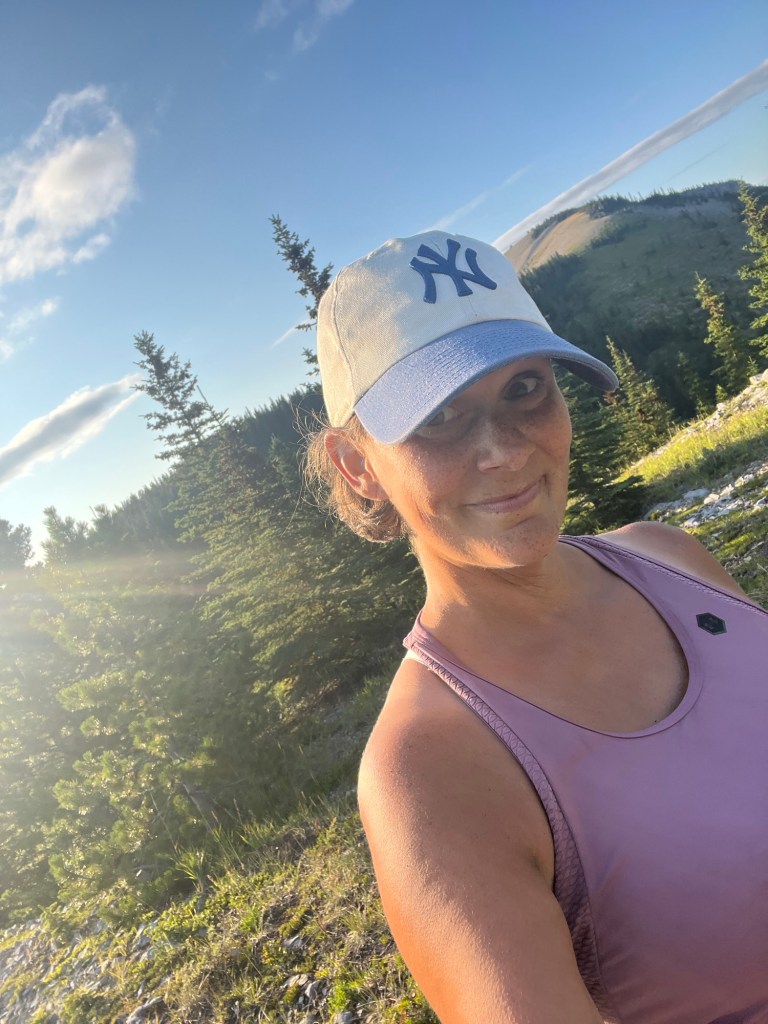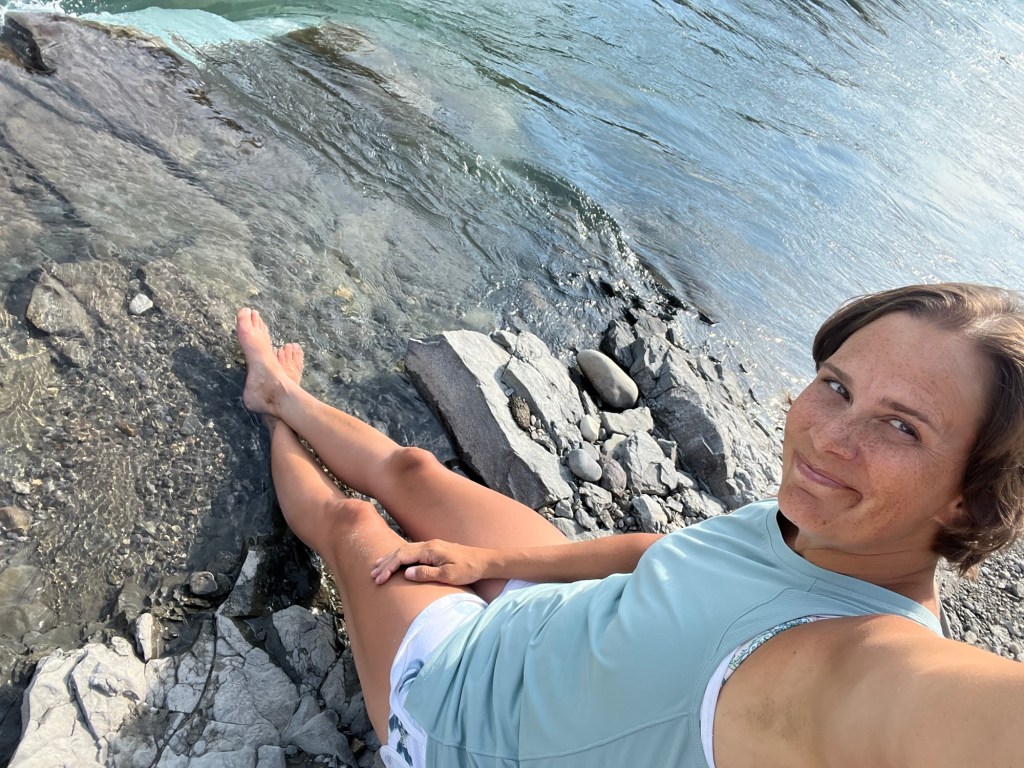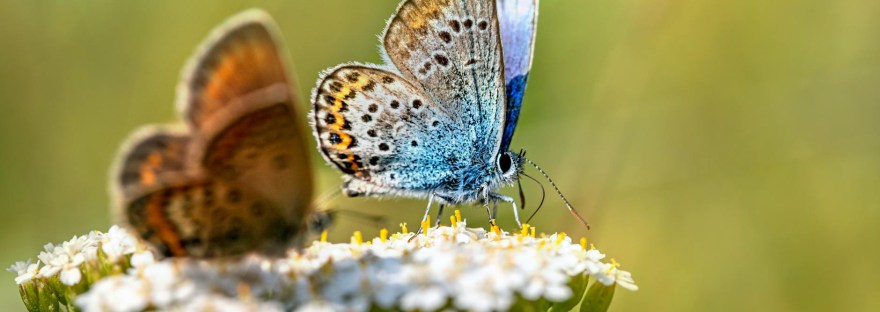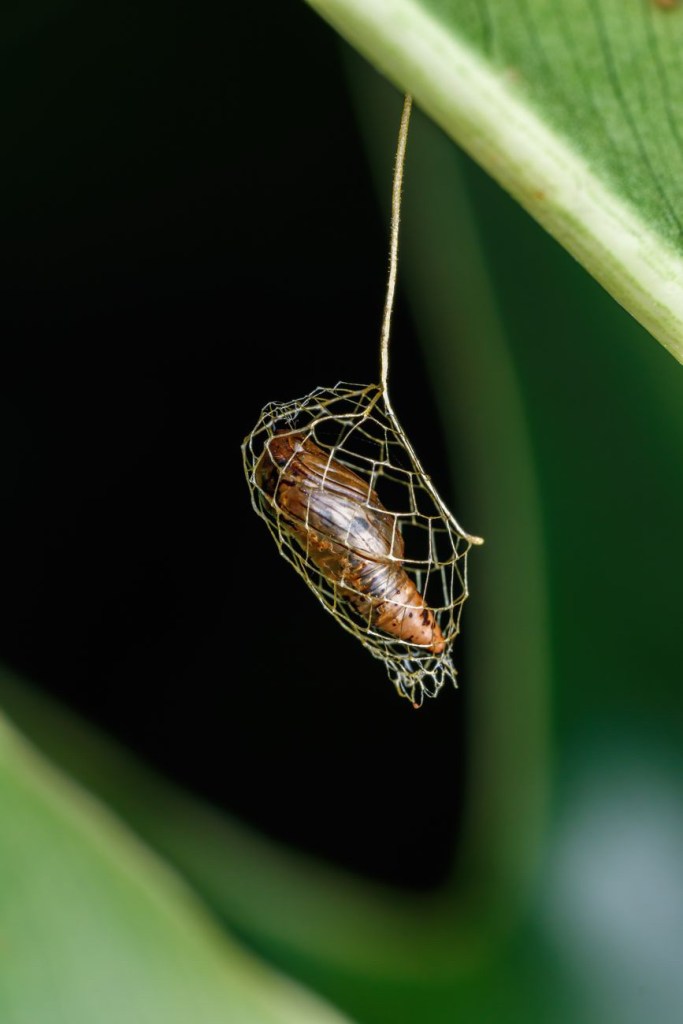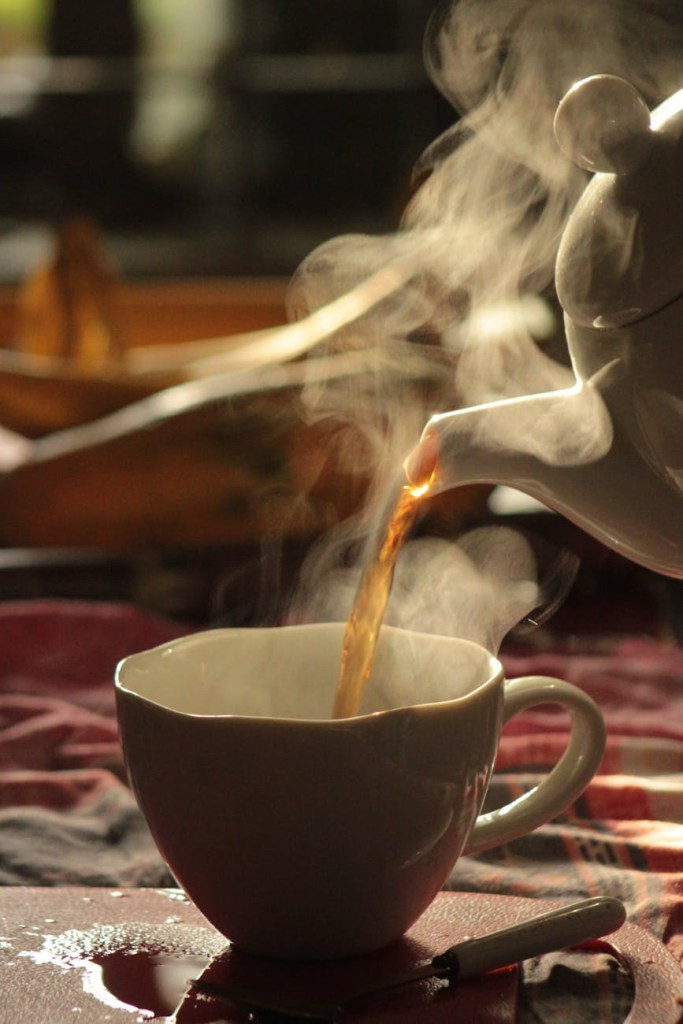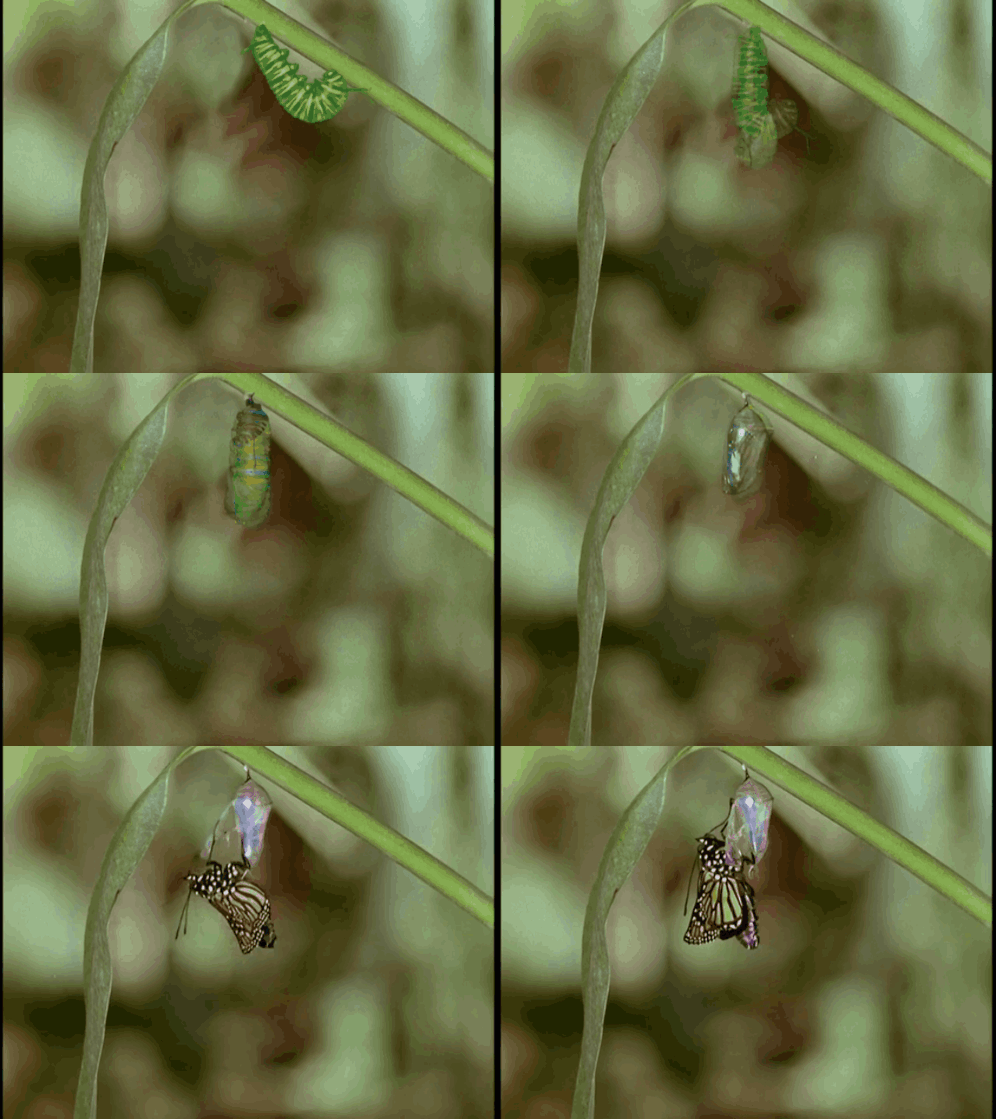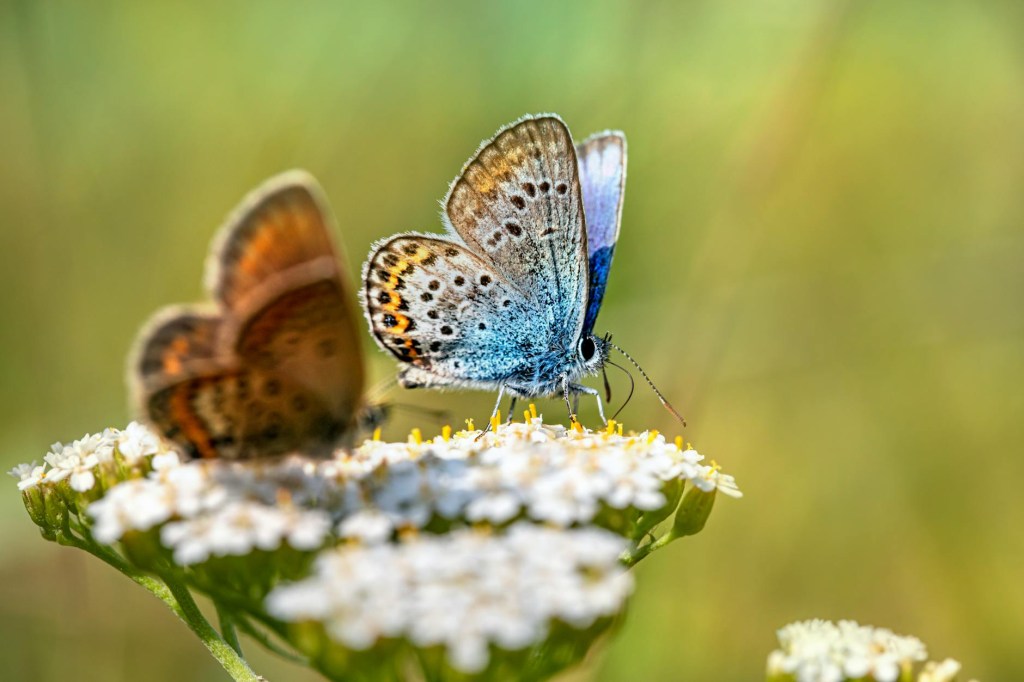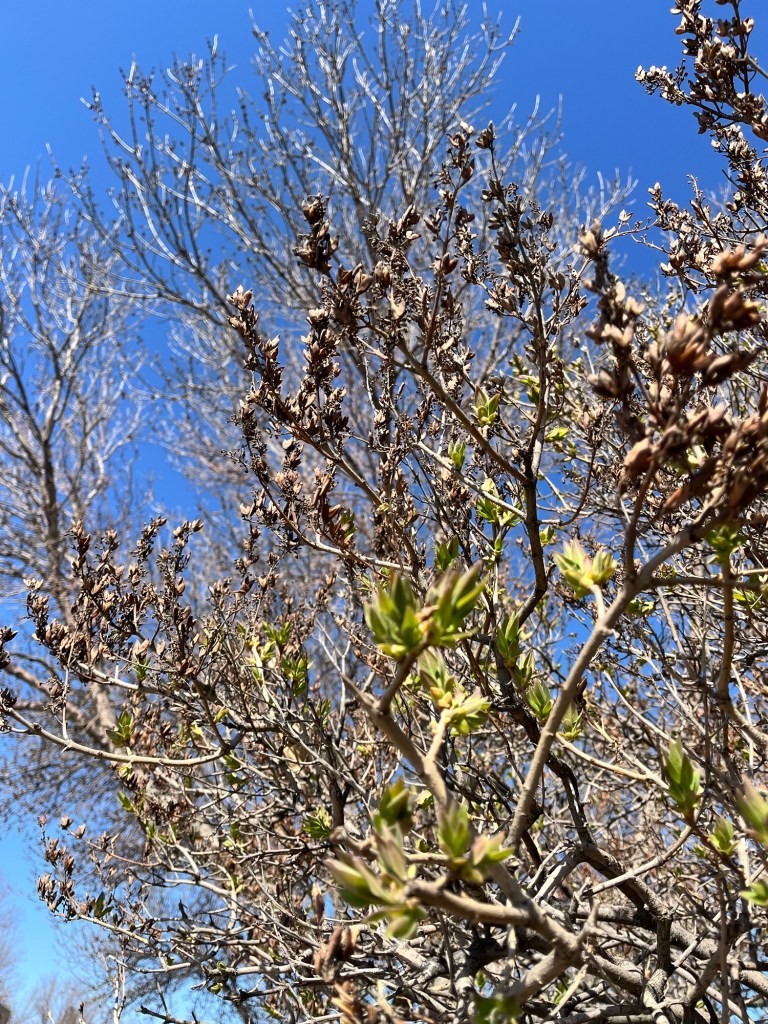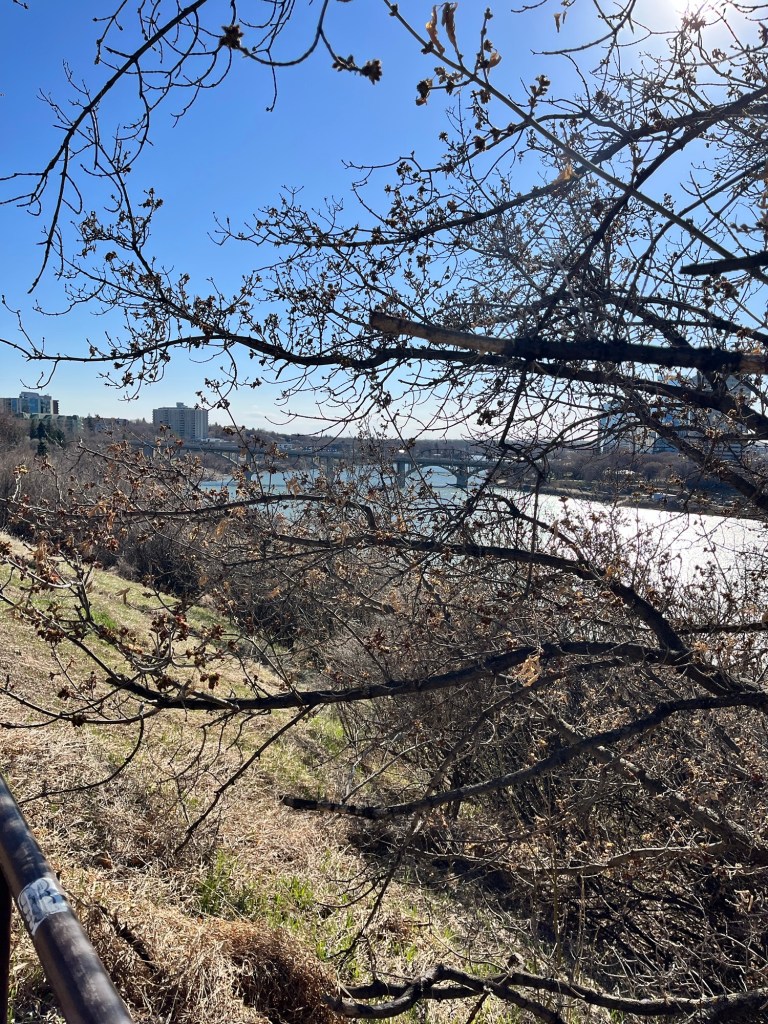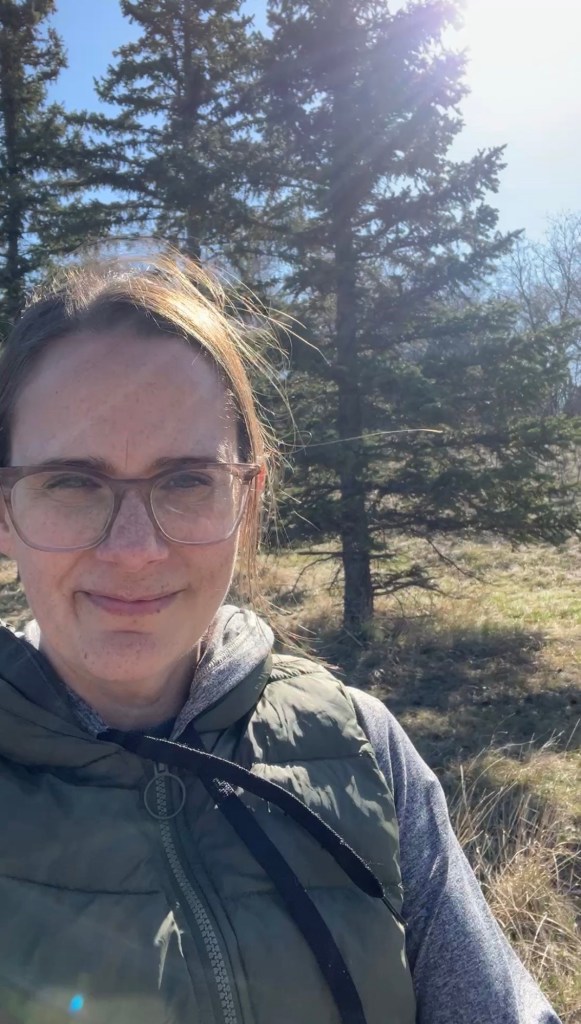

That, perhaps, is the difference between a crisis and a chrysalis. One keeps us frozen in fear. The other slowly reshapes us.
Technically, I’m not even fully in my midlife years yet.
And yet my body arrived early to the party.
A complete hysterectomy fast-tracked me into conversations I thought I still had years to prepare for.
Ironically, some circles don’t allow me in to the conversation because I’m “far too young” to know what menopause is.
It seems my reproductive system retired before society was emotionally prepared to handle it. Medically, I pass the test but I always get ID’d at the door.
I was medically launched into menopause with all the glamorous perks.
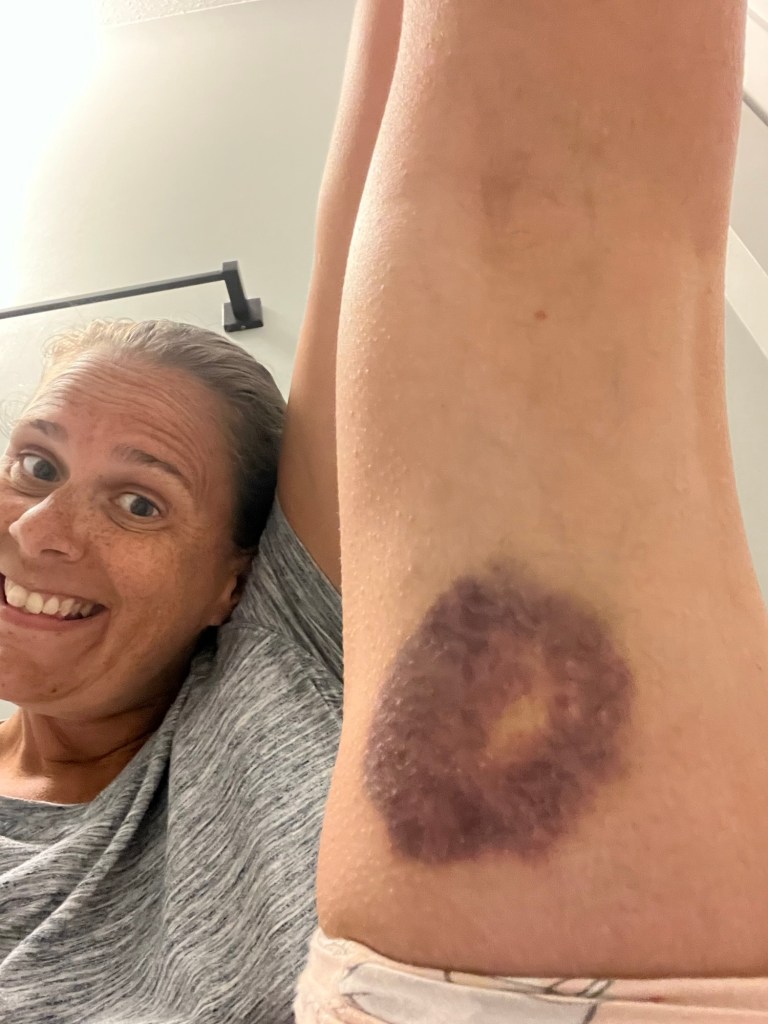
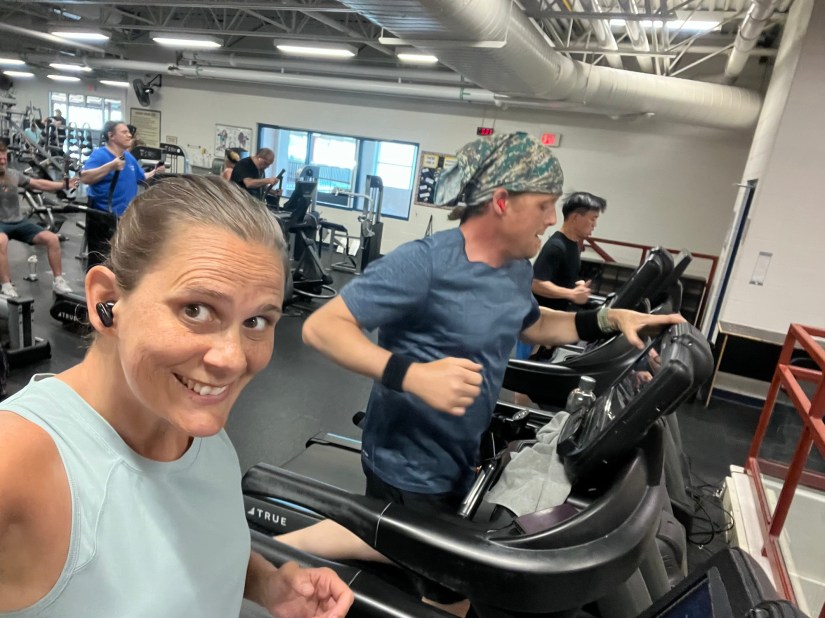
Hot flashes. Joint pain. An increasingly fragile relationship with sleep. And the deeply humbling realization that apparently your underarms and mid range can become flabby despite hours of working out at the gym.
(Nothing prepares you for sneezing incorrectly in your 40s.)
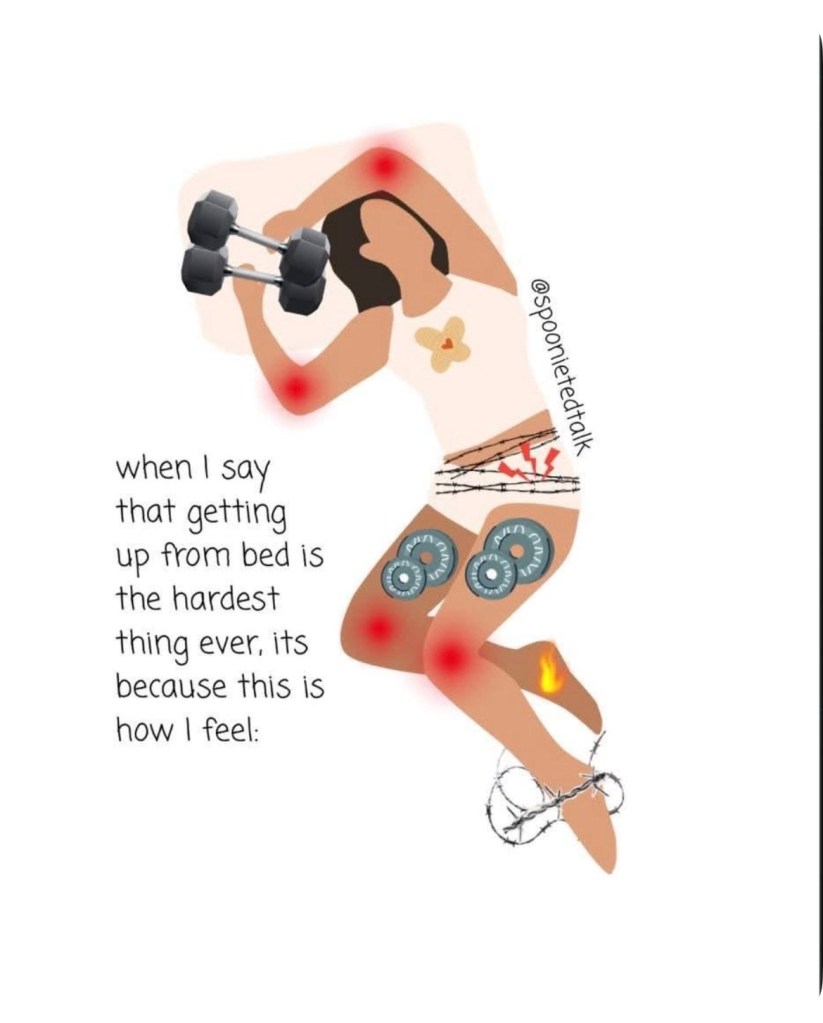
My body has adopted the classic expired warranty strategy, catastrophic synchronized failure. I’ve entered the ‘everything squeaks, leaks, or spasms unexpectedly’ chapter of ownership. My body has moved beyond ‘minor repairs’ and into ‘have you considered replacing the whole unit?’ territory.
Which is why a phrase I recently heard on the podcast Hello Menopause! grabbed my attention.
“Midlife chrysalis.”
Not midlife crisis. Midlife chrysalis.
The episode featured Chip Conley talking about reinvention, and I chose to listen to this episode because crisis sounds like collapse. Losing control. Becoming less.
Like panic bangs and plans to live “off-grid” and taking up emotional support hobbies. Sourdough starter anyone?
But chrysalis?
That sounds like transformation.
Messy. Strange. Hidden. Uncomfortable. Necessary.
A chrysalis says. You are not falling apart. You are simply changing form.
I think many of us who have experienced chronic illness, disability, grief, loss, burnout, etc. arrive at this transformation long before the culture expects us to.
Some of us are forced into reinvention before we even finish becoming who we thought we would be.
The Crisis
Be patient toward all that is unsolved in your heart.
Sometimes crayon. When I need a little more whimsy in my days.
There were years where survival became the main objective. Years where my nervous system felt like a shaken vending machine full of stress hormones. Years where I thought resilience meant pushing harder instead of listening deeper.
And then came the hysterectomy.
One of those dividing-line experiences where life becomes Before and After.
Before, I still secretly believed if I tried hard enough I might someday return to the old version of myself.
After, I slowly began realizing there may not be a way back. Emotional landslides and experiential cave-ins had blocked that passage way.
Forward and through became my only options. Through self-realizations. Humbling concessions. Constant negotiations between mind and body.
And maybe that is where the chrysalis begins.
The Chrysalis
And the day came when the risk to remain tight in a bud was more painful than the risk it took to blossom.
A chrysalis does not look impressive from the outside.
It looks still. Inactive. Even broken down.
But inside? An extraordinary reorganization is happening.
And I think that’s what midlife (or medically-induced midlife-adjacent existentialism) can become.
Not a crisis to survive. But a transformation to participate in. Whole-heartedly.
Chip Conley talked about how the first half of life is often about accumulation.
We gather. Relationships. Responsibilities. Possessions. Roles. Expectations. Obligations. Dreams that once fit.
And eventually we become emotionally overstuffed.
He described midlife as “a great midlife edit.”
As I listened I considered the fact that chronic illness forces the edit whether you volunteer readily or not.
You simply cannot carry everything forever when your body already feels like it’s carrying a weighted backpack full of loose cutlery.
At some point you must ask important questions.
What still fits?
What actually matters?
What has become lukewarm in my life?
Do you know what a lukewarm life looks like? One of the lines from the podcast,
Pouring out part of your tea allows you to pour some hot new tea into the cup.
Because some things are not meant to last forever. Not every friendship. Not every role. Not every expectation you once had for yourself.
And maybe releasing those things is not failure. Maybe it’s pruning.
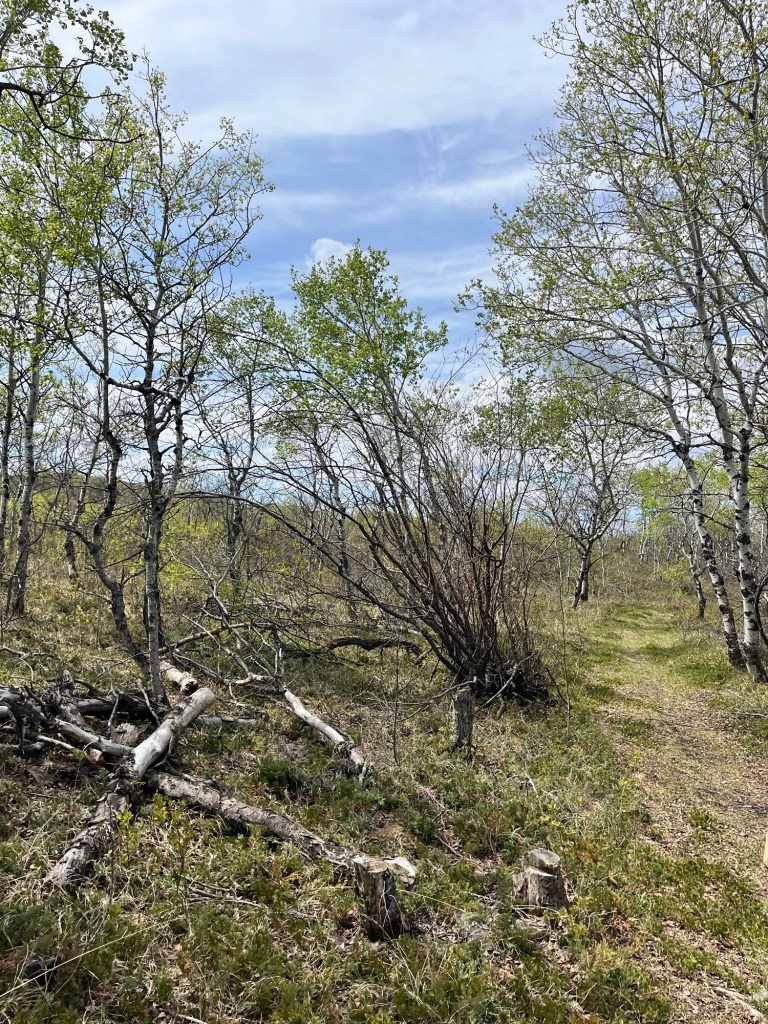
The forest understands this better than we do.
The Forest
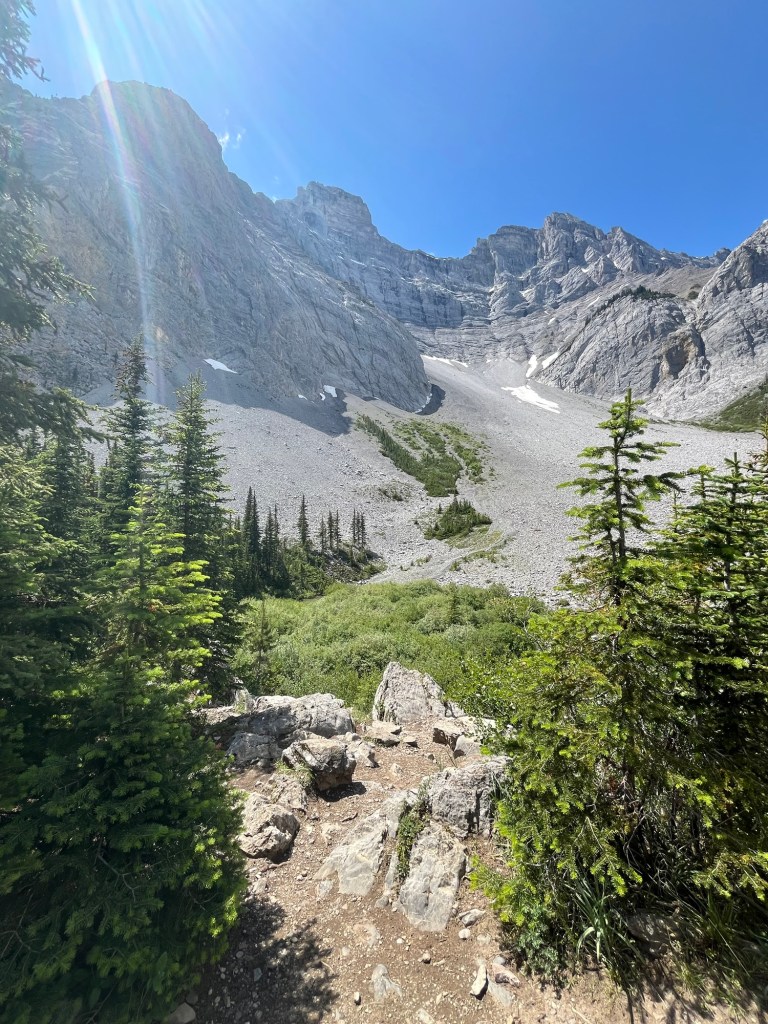
One of the reasons forest therapy has become so meaningful to me is because the forest never panics about transformation.
Forest therapy has taught me that stillness is not the same thing as stagnation. Sometimes what appears dormant is actually becoming. I wrote more about that in this post, Nourish Your Nervous System: Forest Therapy Insights
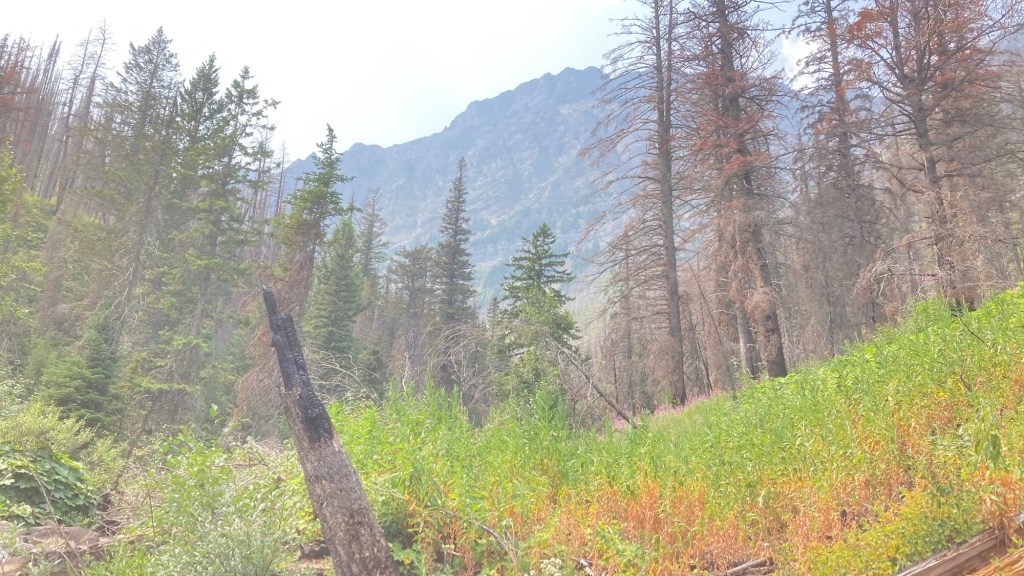
Deadfall becomes nourishment. Burned places grow new life. Trees release entire branches to survive harsh seasons. These changes that seem negative are essential to a healthy forest.
Humans also require those experiences that appear negative and are actually essential for a healthy life.
In the forest, decay and renewal, soft and hard, smooth and sharp are all happening simultaneously.
And honestly, that feels like midlife too.
Especially for those of us living in bodies that have known pain.
We have experienced days where tears of pain rolled down the left cheek while tears of joy rolled down the right.
We know how to hold grief and gratitude at the same time.
That depth changes a person.
We know what it is to laugh in waiting rooms. To find beauty in tiny victories. To feel gratitude and grief sharing the same chair.
I have learned that emotional pain cannot simply be numbed away the same way physical pain can. There is no ibuprofen for identity loss. No heating pad for disappointment. No prescription for becoming someone new.
And while suffering itself is not noble, I do think deep experiences deepen people.
My chronic comrades know this.
Pain can also make people bitter, stuck, isolated, hardened.
That, perhaps, is the difference between a crisis and a chrysalis. One keeps us frozen in fear. The other slowly reshapes us.
If we allow ourselves to learn from it. We can become more compassionate. Tender. Wise. Present. Better able to sit beside someone else’s suffering without looking away.
As they said in the podcast,
Our painful life lessons are the raw material for our future wisdom.
I believe that in my soul.
The Offering
Sometimes our culture subtly teaches that the people worth listening to are the successful ones. The polished ones. The credentialed ones. The endlessly productive ones
What can we do about this imbalance? If you ever deem somebody less than you… ask yourself what they can teach you.
Because some of the wisest people I know have had their lives interrupted.
Some had to abandon dreams they loved. Some never got the education they were capable of and deserved. Some are rebuilding lives with parts and pieces they never would have chosen.
And still. They carry wisdom.
Do not think less of yourself because your life required adaptation. You are not behind because your path bent unexpectedly.
Some of us have earned emotional depth the hard way.
And if you cannot live the exact life you once pictured?
Find something to run toward anyway.
Even if your pace looks different now. Even if you have to limp toward it some days. Even if your dream has changed shape entirely.
A chrysalis does not become what it originally was.
That is the whole point!
A Forest Therapy Invitation: Chrysalis Walk
The next time you’re in a forest, park, or tree-lined path, try this:
Walk slowly and notice signs of transition.
What is decomposing?
What is emerging?
What is shedding?
What is adapting?
What still carries beauty despite visible damage?
Then ask yourself:
What version of myself am I grieving?
What no longer fits?
What wants to emerge now?
What if this season is transformation instead of failure?
You do not need immediate answers.
The forest is always becoming new. Slowly. Over time.
The Question
One question from the podcast we can all ask ourselves,
Ten years from now, what will I regret if I don’t learn or do now?
Conley called anticipated regret a form of wisdom. Chronic illness teaches you that later is not guaranteed. Perfect timing is imaginary. And someday can become never surprisingly fast.
So maybe this chapter is not about trying to reclaim who we once were.
Maybe it is about becoming more fully ourselves.
Hot flashes. Heating pads. Existential growth. And all.
What the caterpillar calls the end of the world, the master calls a butterfly.
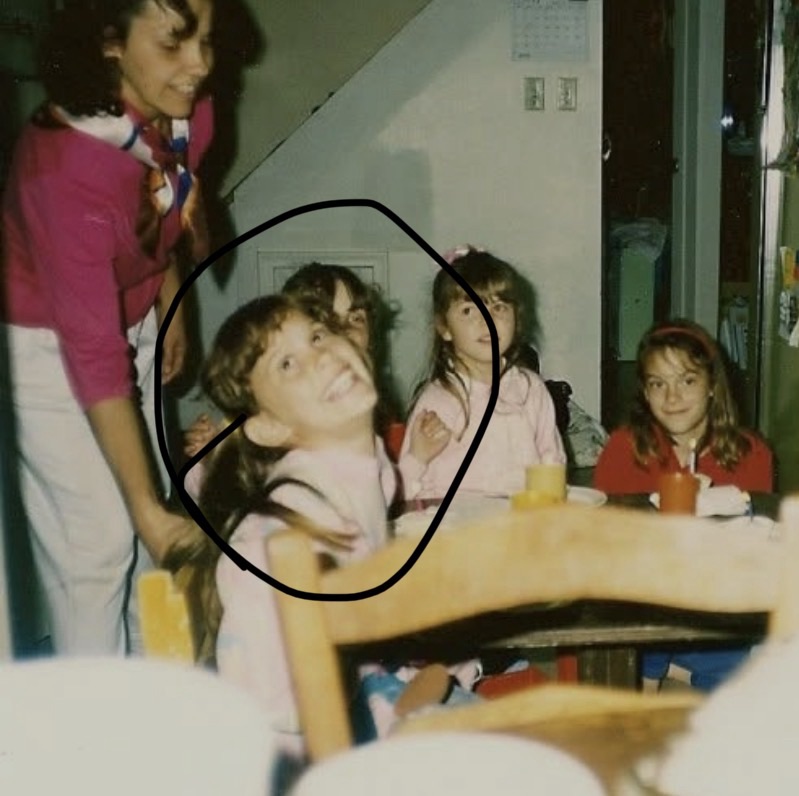
Back in my day, some kids brought hockey cards and sticker collections to school. I brought an alarming range of ligament-based entertainment.
Sometimes hypermobility first appears as a child who seems unusually bendy or clumsy, often both at once. 🙋♀️
The child who sits in a W position on the floor because it feels natural. The one who, without pausing to question it, contorts themselves into strange positions during movie night.
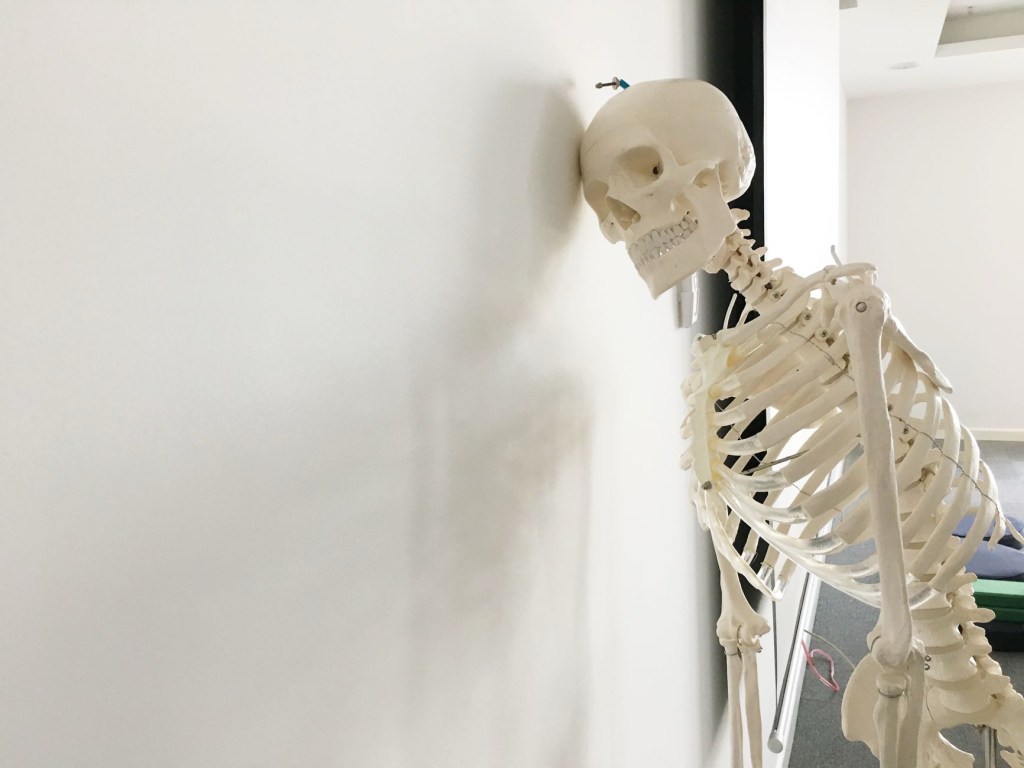
What they may not see is the child constantly running into walls because their body struggles to map itself properly in space. Bruises appearing mysteriously across shins. Ankles rolling on flat ground. Sleeves chewed because pain and overstimulation are difficult to explain at seven years old.
And then there are the “growing pains.”
Except many children with connective tissue disorders experience pain far beyond the occasional ache adults remember from childhood.
Deep bone pain at night. Legs throbbing so intensely sleep becomes impossible. Crying after gym class. Exhaustion after seemingly normal activities.
Many hypermobile children become experts at masking early. They laugh while joints slip. They keep playing while hurting because they assume everyone else feels this too.
Some become the “dramatic” child. Others become the “tough” one.
Honestly, I was the child trying to survive in a body I did not yet have language for.
What am I even doing bending my neck like that?
The thumb that bends too far backward. The knees that point in unusual directions. The shoulder that clicks when slipping in and out. Being crazy talented in a yoga class my first day.
What people don’t see is that connective tissue is not merely a few loose ligaments behaving badly.
Connective tissue is infrastructure.
It is the architecture holding the body together. The webbing woven through blood vessels, skin, organs, fascia, tendons, heart valves, lungs, digestive systems, pelvic floor, eyes, nerves, and joints. It is scaffolding. Suspension bridge. Packaging tape. Elastic waistband. Shock absorber.
And when connective tissue is faulty, life can begin to feel like living in a house where every screw has loosened itself by half a turn.
Not enough to collapse all at once. Enough that everything creaks. And left unchecked, more and more areas become unstable, then require constant repairs. Eventually some rooms just become unusable.
A Sad Commentary: AKAMy Brush with Organized Sports
My joints approached organized sports with more enthusiasm than stability. More optimism than skill.
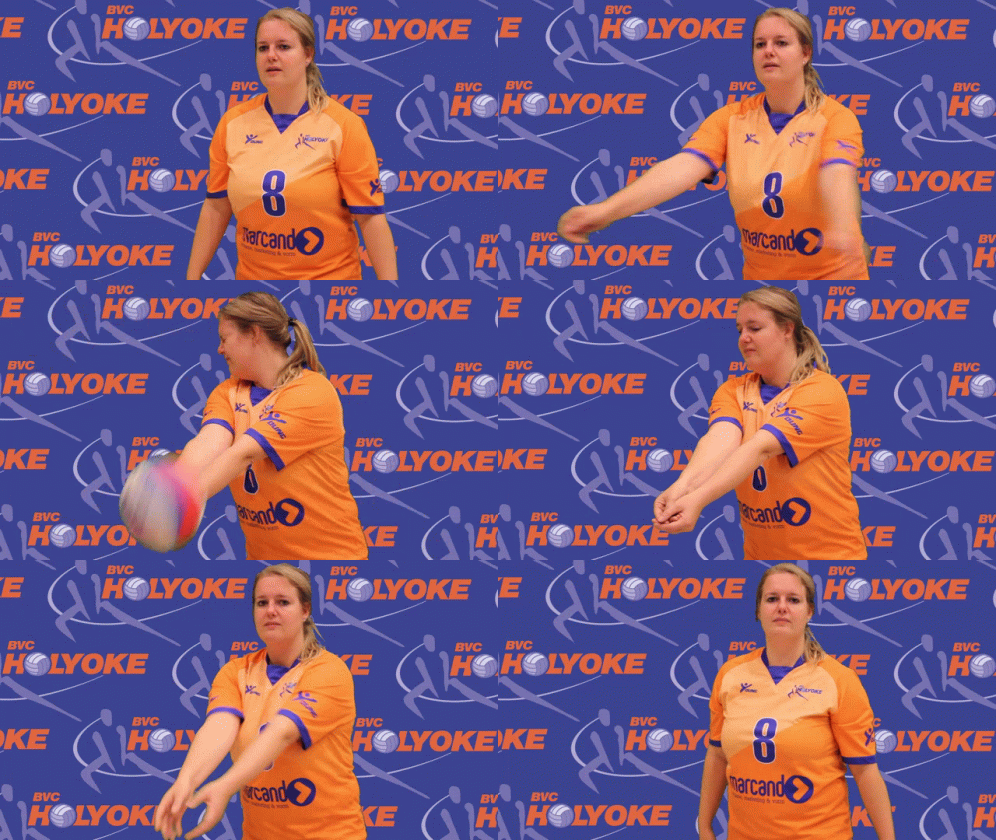
In a small town, everybody played volleyball or there simply wasn’t a volleyball team.
So I played volleyball.
I hated it.
Looking back now, I wonder why I stayed in as long as I did. Every practice left my forearms covered in bruises. Big ones, tiny ones, overlapping ones. I looked part Dalmatian. Nobody else seemed to bruise like that, so naturally the conclusion was that I was doing it wrong.
Turns out my connective tissue was doing it wrong. Not me.
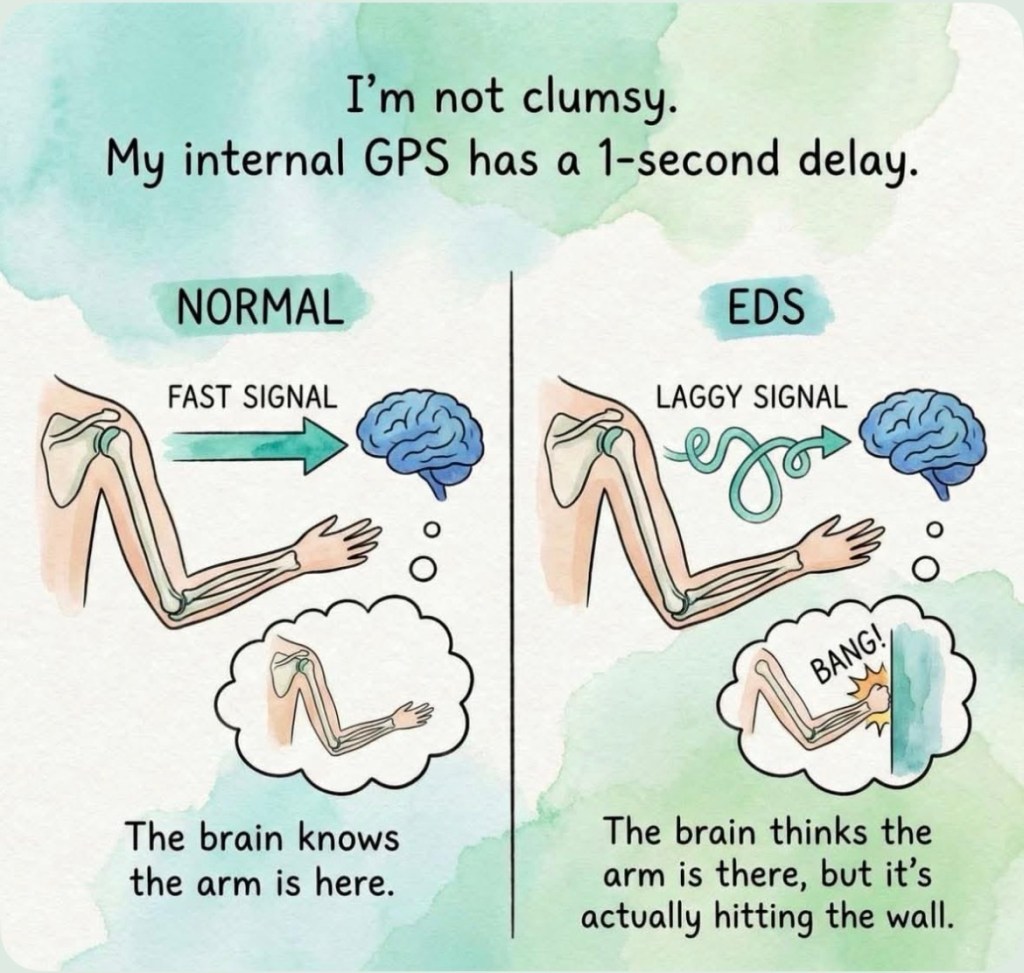
I was terrible at volleyball. Not for lack of trying, either. I could picture exactly what my body was supposed to do, but the execution never matched the image in my head. It always felt like there was a lag between my brain and my limbs, like someone had replaced my coordination with an unreliable Wi-Fi signal.
The only part of volleyball practice I excelled at was stretching.
That should maybe have been a clue.
I could also run forever, but the muscle fatigue before, during, and after was brutal. My legs and ribs constantly felt tight and overworked, like my muscles were trying to compensate for a body that refused to stabilize itself properly.
The solution offered to me was always the same: “Practice more.” “You just need to focus, Pam.” “Try harder.” “Don’t give up so easily all the time.”
My P.E. teacher, who was also my coach, and I were not exactly compatible personalities. I suspect I ranked fairly high on his “lazy kid” list. My feelings toward him and his teaching style don’t need to be discussed for the purpose of this post. Perhaps he was doing the best he knew how 🤷♀️.
What hurt most was that I wasn’t used to being bad at things.
I excelled in music. Dance. Academics. If I tried something, I usually became good at it eventually. But anything involving proprioception. Balance, coordination, spatial awareness, reaction time, exposed a kind of weakness I couldn’t outwork.
No matter how hard I tried, my body never responded the way everyone else’s seemed to. I felt like I was being asked to build a stable life with elastic bands where other people were given rope.
After enough years of that experience, something in me quietly stopped trying.
Not everywhere. Just there.
I realized I could put in enormous effort and still end up with roughly the same P.E. grade as the kid half-heartedly wandering laps around the gym. So eventually, I became that kid instead. The one at the back of the class who didn’t seem invested. The one teachers assumed didn’t care whether they passed.
Stemming from humiliation in trying my hardest while looking like a fool and as though I wasn’t trying at all.
It’s an incredibly discouraging place for a young person to live.
Some kids are exhausted. Discouraged. In pain. Disconnected from bodies that refuse to cooperate. In retrospect, my body had all the stability of a shopping cart with one bad wheel.
The whole point of physical education is supposedly to encourage lifelong movement and confidence in your body.
Ironically, I now walk everywhere, go to the gym regularly, and deeply value movement. I suspect that may not be the case for those classmates that achieved gold stars for gym class back in the day.
Children are often graded on visible performance without anyone asking what invisible barriers may exist underneath it. 🍌 🍌 🍌
And maybe that experience is part of why I later felt drawn toward educational support work. Because I remember exactly what it feels like to be misunderstood in a classroom. To be trying harder than anyone realizes while appearing like you are trying the least.
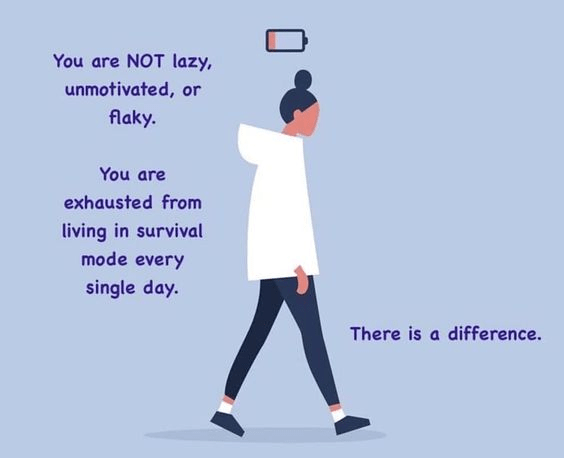
Some kids are not lazy.
Sometimes what looks like apathy is actually years of silent defeat.
So MuchMore Than Loose Joints
My body has taught me that fragility and resilience are not opposites. Sometimes they exist in the very same tissue.
People often imagine connective tissue disorders as orthopedic inconveniences.
A sore knee. An ankle sprain. Being exceptionally bendy.
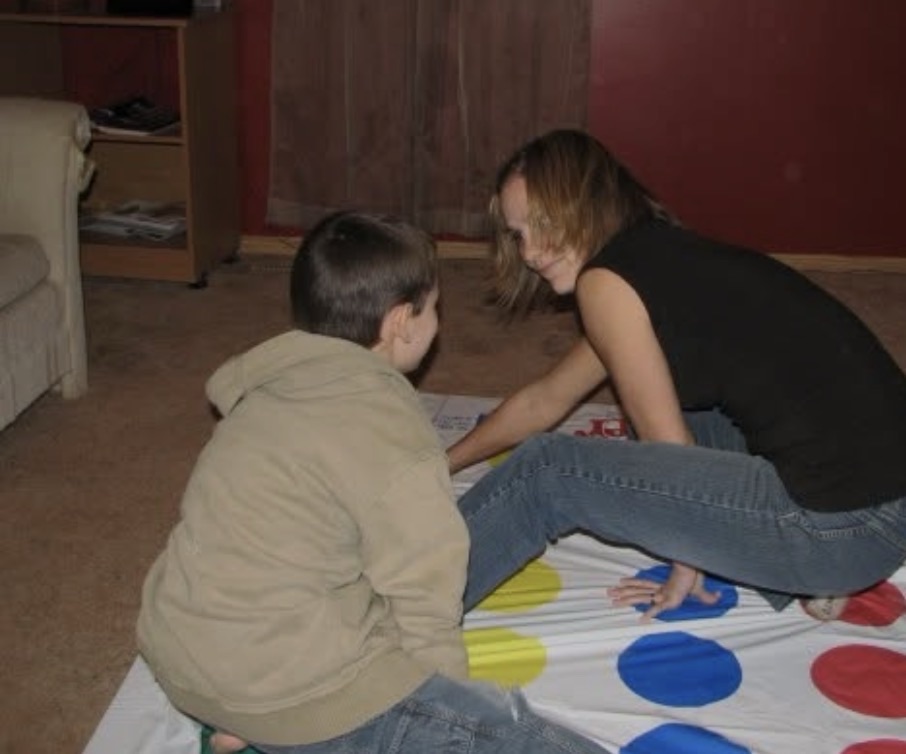
Playing twister with my now-26-year-old. Not to brag, but I was very good.
But connective tissue does not politely stay in one department.
It influences how blood vessels constrict and relax. Why standing up can feel like gravity suddenly doubled. Why heart rates race while brushing teeth. Why exhaustion arrives not after effort, but before and during it.
It influences the skin. Fragile, stretchy, slow to heal, easily bruised.
It influences digestion. Because the digestive tract also depends on connective tissue and smooth coordination. Meals become negotiations instead of nourishment.
It influences breathing. Because the rib cage, diaphragm, and tiny structures supporting the lungs are all part of the same interconnected story.
It influences pain. Not only through injuries, but through a nervous system constantly adapting to instability. Muscles tighten to compensate. Fascia braces. The body learns vigilance.
Even sleep can become difficult when the body spends the entire night trying to hold itself together. Some people wake up refreshed. My body wakes up looking like I’ve been assembled with spare parts in low lighting. Like sleep happened near me but not directly to me.
There is loneliness in illness that hides in plain sight.
You may look healthy while internally calculating:
Can my hips handle this chair? Will my spine tolerate the drive? How long before the fatigue crashes in? Is today the day I sustain an injury that sets me back a year?
People see the smile at the gatherings. They do not see the cost afterward.
The Forest Never Demands Symmetry
One of the reasons forest therapy can feel so healing for those with any type of disorders is because the forest does not care about perfection.
Trees twist toward light. Branches split and regrow. Moss softens fallen things instead of condemning them.
In the forest, support is collaborative.
Roots intertwine underground. Fungi trade nutrients between struggling trees. Fallen logs become nourishment for future life. Nothing survives entirely alone.
For people living in bodies that require adaptation, slowness, pacing, and care, the forest offers a radically compassionate model of existence.
Nature does not measure worth.
Walking Practice: “Borrowing Stability”
This forest therapy practice can be done slowly while walking a trail, sidewalk, park path, or even your backyard.
As you walk, notice what in the landscape appears stable.
Perhaps it is:
the rootedness of a tree
the reliability of stone
the rhythm of wind
the resolution of moss growing over rough surfaces
Without forcing positivity, simply observe.
Now begin walking more slowly.
As each foot touches the ground, imagine you are borrowing steadiness from the earth beneath you.
Not fixing yourself. Not overcoming your body. Borrowing support.
You may silently repeat:
Supported. Held. Connected.
If your body hurts while walking, let the practice include that truth instead of resisting it.
Forest therapy is not about pretending discomfort away. It is about allowing yourself to belong exactly as you are.
Pause occasionally and place a hand on a tree trunk, railing, stone wall, or your own chest.
Notice:
What supports you physically?
What supports you emotionally?
What support have you been refusing because you are used to surviving alone?
Continue walking without rushing toward insight.
Sometimes healing begins the moment we stop arguing with our pace.
The Grief No One Talks About
There is grief in becoming intimate with limitation.
Grief when your mind has cheques your connective tissue cannot cash.
Grief when symptoms multiply like unwanted groupies: fatigue, dysautonomia, chronic pain, migraines, digestive problems, instability, inflammation, sensory overwhelm.
Many connective tissue disorders do not travel alone. They tend to arrive in flocks.
Not the polished beauty of wellness culture that insists healing should look photogenic and triumphant. Complete. Universal.
But a quieter beauty.
The beauty of learning to listen deeply to others. The beauty of noticing small joys because large ones became inaccessible. The beauty of becoming tender toward bodies. Your own and others’. The beauty of discovering that a meaningful life was never dependent on being free from pain.
I spent years believing my body’s limitations were character flaws. Turns out that limiting belief was false. Those limitations have helped me become the person I am.
To be rooted is perhaps the most important and least recognized need of the human soul.
Research continues to show time in forests can help regulate the nervous system, reduce stress hormones, lower heart rate, and support emotional well-being. But for those living with connective tissue disorders, the benefits often go deeper than measurable metrics.
Forest therapy gives permission to:
move slowly
rest without guilt
reconnect with sensory pleasure
soften hypervigilance
leave productivity behind temporarily
remember you are more than symptoms
When the nervous system lives in a constant state of adaptation, gentle sensory experiences matter.
The sound of leaves moving overhead. The coolness of shade on inflamed skin. Birdsong interrupting anxious thoughts. The visual softness of green.
None of these cure a connective tissue disorder.
But they can create moments where the body feels less at war with itself.
And moments matter.
Especially when stitched together over time.
A Beautiful Life Can Still Grow Here
Instructions for living a life: Pay attention. Be astonished. Tell about it. — Mary Oliver
Living with a connective tissue disorder may mean your life unfolds differently than expected.
More pauses. More recalculating. More adaptation.
But different is not lesser.
Some of the most compassionate people are those whose bodies taught them interdependence.
Some of the most observant souls are those forced to slow down enough to notice life carefully.
The forest reminds us that resilience is not hardness.
Resilience is flexibility. Relationship. Return.
And perhaps that is fitting for people made of connective tissue. Those who understand, more than most, that life is ultimately about connection.
Not perfect strength. Not endless endurance.
Connection.
To the earth. To one another. To moments of beauty that still arrive, even here.
To tell me I cannot run is to hold my body in contempt.
-Friedrich Nietzsche
This past weekend I was out boating with friends. The sun was shining, laughter was everywhere, and the water was perfect. My absolute favorite kind of day. Until it wasn’t.
The beach is so amazing. We all lay around in our undies with complete strangers eating sandy sandwiches and chips. What a world!
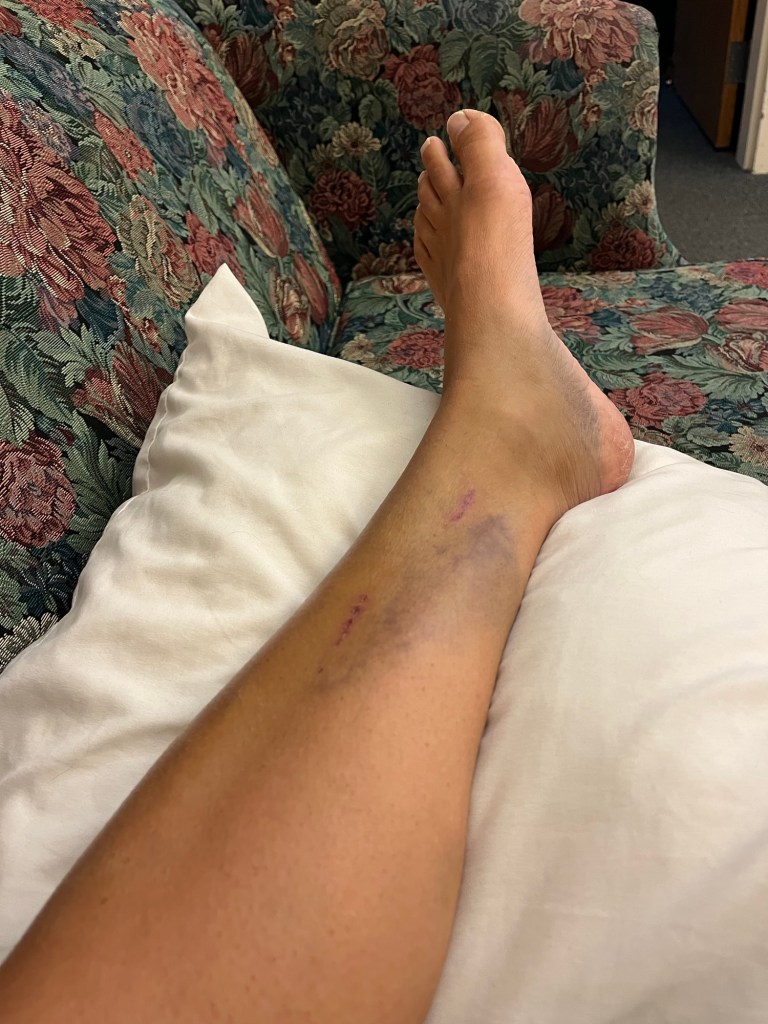
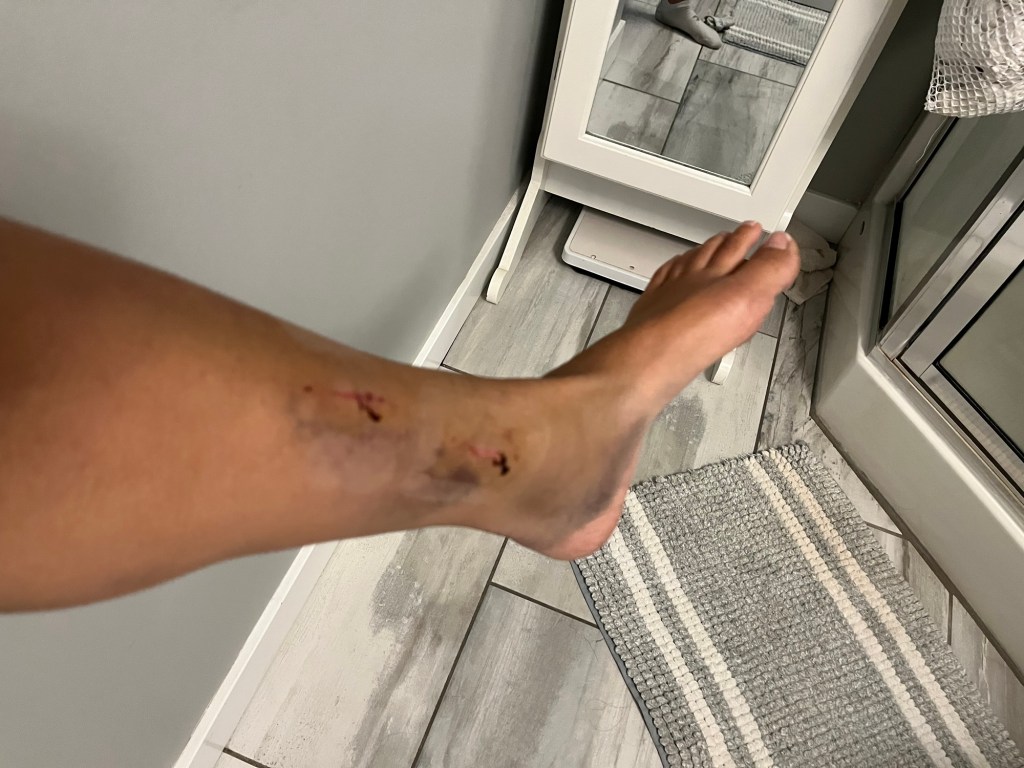
But this trip was too eventful for me. I slipped off the back of the boat. A simple misstep—my foot chose the slippy part before the ladder instead of the grippy part. My skin slid down the metal and scraped in a couple of places. For most people, it would be a painful annoyance. Maybe a couple of Band-Aids and an “ouch” when the rubbing alcohol stings.
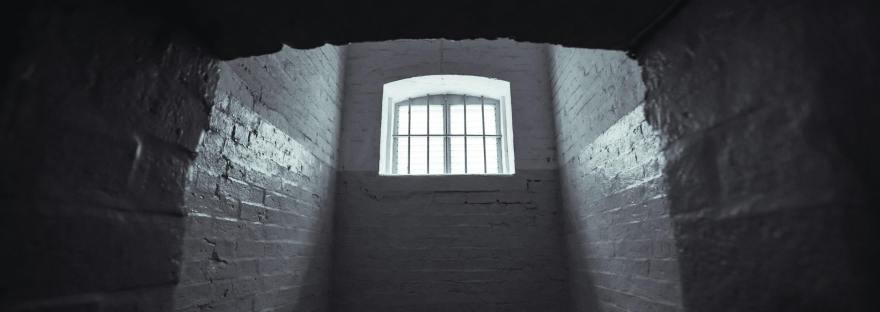
But for me, with a connective tissue disorder, a “minor” injury isn’t minor. It’s my own prison sentence.
Day 3 post slip
The moment my leg hit and the skin tore, my body responded like a toddler throwing a tantrum. Two points, swelling to the size of small eggs appeared instantly. My vision swam, nausea hit, and I nearly fainted. I had to be rushed off the beach. Reluctantly, I might add. I just wanted to stay and play. 🤷♀️
And yet, as I moved it around, the swelling went down. After a few ginger steps, walking proved feasible. So, I stayed on the beach. Carefully. Pretending things were fine. Until the next day, when I accidentally touched one of the angry spots and nearly fainted again from the pain. Cue swelling, round two.
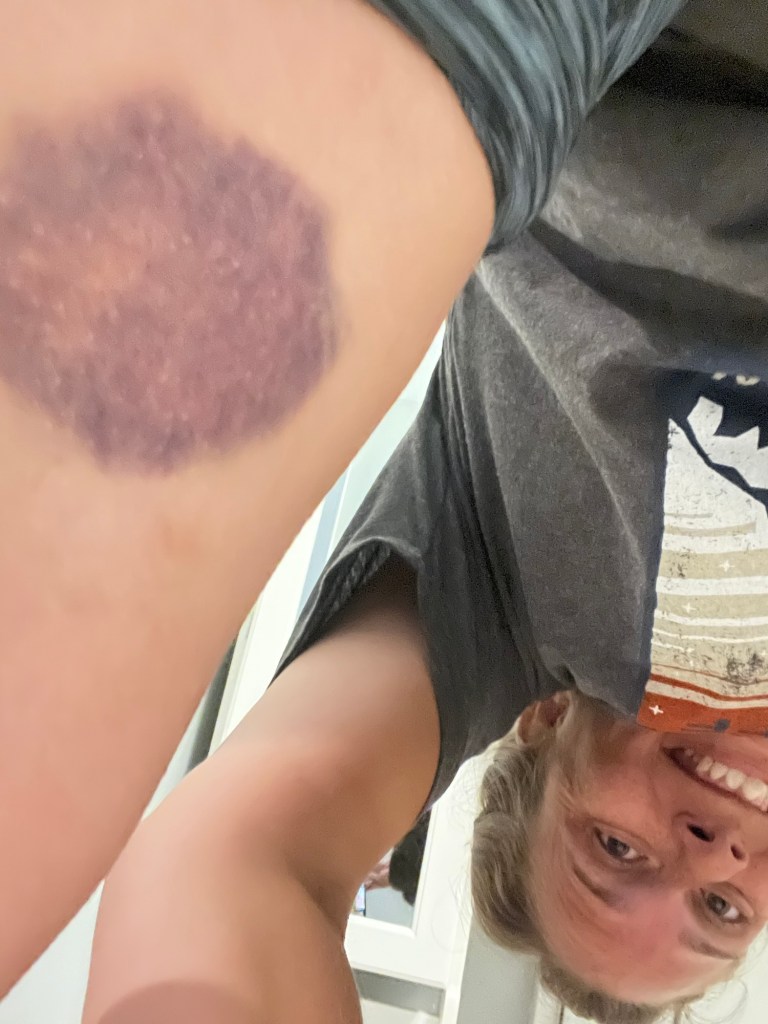
This bruise on the back of my leg also happened in the fall.
Nothing feels broken. This isn’t a cast-and-crutches type of injury. This is a – my tissue is angry and having a meltdown kind of injury. The kind that will ripple through every layer of healing, slowly, stubbornly, piece by piece.
The Cascading Consequence
Here’s what happens with mobile joints and connective tissue disorders:
Immediate tantrum. Tissue swells, pain spikes, body goes into shock.
Muscle aftermath. Even if the muscle wasn’t directly injured, it’s recruited in the act of catching yourself, and now it’s tight, inflamed, and waiting its turn to protest.
The balancing act. I need to keep running to maintain the strength that keeps my joints in place, but I also can’t overwork what’s injured.
Scar tissue sneak attack. When scar tissue forms, it doesn’t just “heal.” It tugs on joints already prone to slipping, pulling them out of place.
This 👆is why what looks minor to you becomes a long-term balancing act ⚖️ for me.
There is no test, no monitor, no scan that can tell us exactly what’s happening.
It’s me, listening to my body.
And my physiotherapist J, patiently piecing me back together one session at a time.
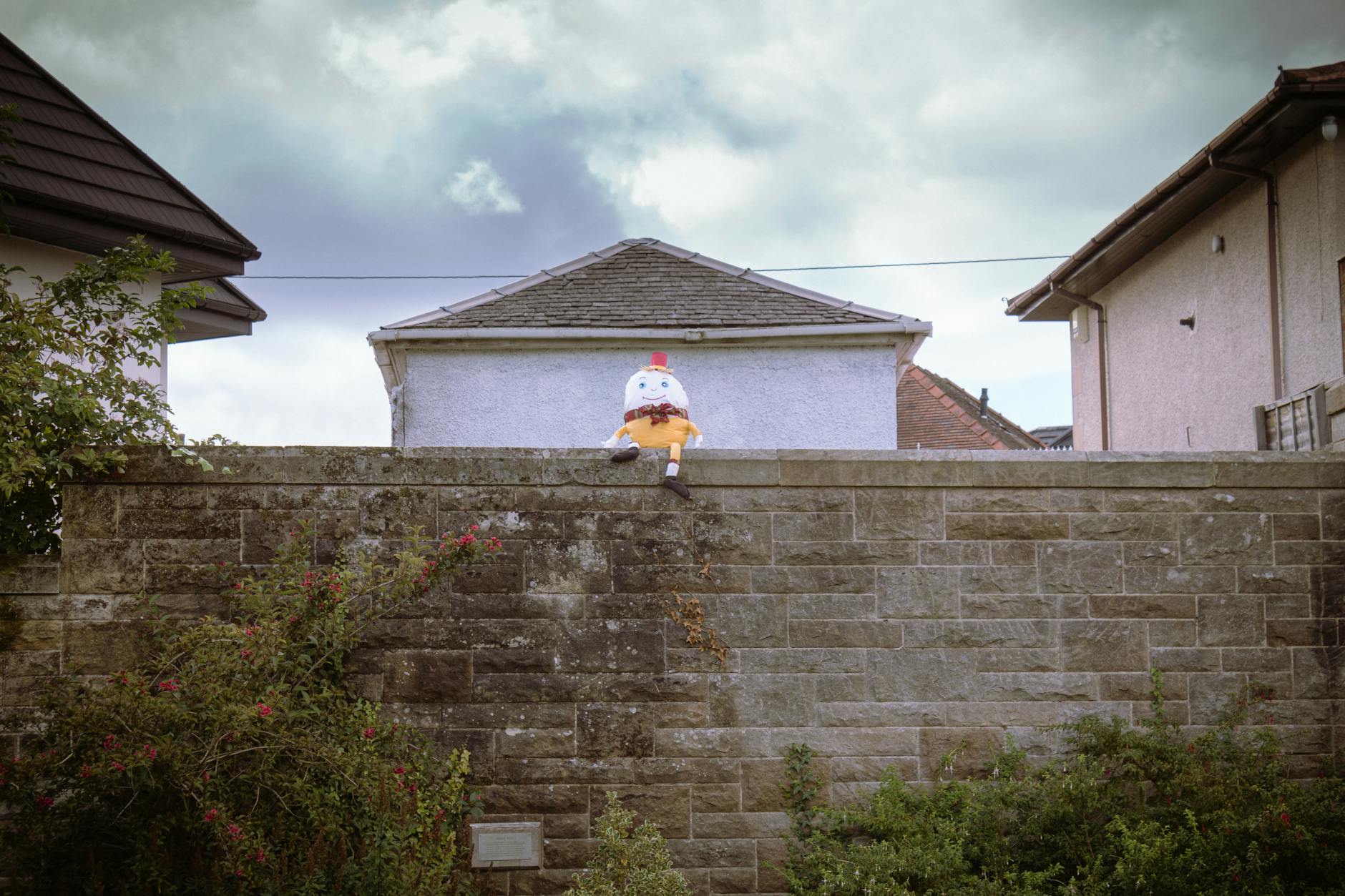
👆🏼 Me as Humpty Dumpty right before needing to be put back together again. 👆🏼
What most people heal from in days, I will heal from in months. 🗓
K️oekentroost
Dutch. “the emotional support cookie you eat after a mildly inconvenient day. (in my case it will be pretzels dipped in nutella)
The Weight of Waiting
The hardest part isn’t the pain. It’s the waiting.
Waiting to run.
Waiting to trust my joints again.
Waiting to see what the scar tissue will do this time to wreak havoc.
It feels like all the work I’ve put in at the gym—months of biking, running, strengthening—could slip away in the span of a single misstep.
That’s the prison. The confinement. The pause button ⏸️ on a life I’ve fought so hard to keep moving ▶️ .
Forest as Healer
But here’s where I return to what always saves me: the forest.
When I step (or hobble) into the trees, I remember that healing doesn’t always look like forward motion. Sometimes it looks like stillness. A dense canopy could be covering spectacular growth. The river’s gentle flow might be a glimpse of the heavy current below. The trees stand, patient and unwavering, reminding me that growth and repair take the time they take.
Forest therapy gives me what no physiotherapy session can: the intuition to hear what my body is really saying.
My blessing in life is to have a physiotherapist that encourages me to spend time there. And to follow my body’s intuitive pace and direction. J pursues us and provides support along the way.
It’s in the quiet green spaces 🌲 where I learn when to push 😖 and when to rest 💤 . Where I can breathe out the frustration 😮💨 and breathe in the steadiness of the earth 🌍 beneath me.
It is in the forest where I believe that healing isn’t just possible—it’s already happening.
When you read the list of benefits, do you see the connection? Grounding will be one of my greatest therapies in each phase of mending.
Words to Carry Me
“Adopt the pace of nature: her secret is patience.” — Ralph Waldo Emerson
“And let us not be weary in well doing; for in due season we shall reap, if we faint not.” – Galatians 6:9
“The trees that are slow to grow bear the best fruit.” – Moliere
“Even the strongest storms don’t last forever. The sun always returns to the forest.” – Unknown
And she will keep coming back to life, over and over again, because beneath the skin of this gentle human lives a warrior unstoppable.
-Annabelle M Ramos
Healing with mobile joints is a marathon made of tiny sprints and long pauses. It’s the art of balancing strength with surrender. And when the world feels like it’s closing in—when a scraped leg feels like a prison sentence—the forest opens its arms and says, you are safe here. Take your time. Heal.
And sometimes I have kept my feelings to myself because I could find no language to describe them in. – Jane Austen
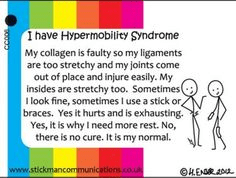
I had a cousin at a family reunion ask me what it is like to have a connective tissue disorder. For anyone that is familiar, I have something close to Ehler’s Danlos Syndrome. Essentially what that means is that I have extremely mobile joints.
My cousin inquired how such a thing affects my day to day life. The question was so kind and thoughtful but I was thrown off guard.
Trying to sum up my medical history and symptoms and how it has affected me in the past and how it affects me now is like trying to perform open heart surgery with a Degree in Finance and the tweezers from the game of Operation.
My mind was starting to poke at a few entry points but it’s so all encompassing. I couldn’t find a place to start.
I was saved by the commencement of a presentation that we both wanted to watch. I didn’t end up answering her question.
But it is a query to which I’d like to be able to respond. I am going to attempt to do so here.
MY main issue with hypermobile joints is that, as the song goes, Every Now and Then I Fall Apart. Except every now and then should actually be all the time. I am lucky enough to have some ligament strength. There are those who suffer much worse than I do.
Collagen is the glue that holds our bodies together and gives our tissues their strength. It affects our skin, bone, muscles, cartilage and organs. So when we are asked what part hurts… it’s just easier to ask what doesn’t hurt.
My connective tissue disorder is nothing compared to what others go through. As with so many disorders there is a spectrum to illustrate the severity. While there are others who suffer more than I do there are also those who suffer less. To clarify, I am not talking here about occasional aches and pains. That pain is also valid. But we can all agree it does not grant understanding of chronic pain/ illness.
Mercifully, I don’t suffer from dislocations. Only from tiny subluxations all over my body. They are sometimes referred to as tiny traumas. That makes them sound so cute.
Your joints are supposed to slide around in their sockets. But with a connective tissue disorder, your ligaments and tendons don’t have the strength they need to hold you from sliding out too far. Once it goes past a certain point, the bone will get stuck. This is called a subluxation and will need manipulation or massage to get it back in place.
I’m not sure how this manifests in the lives of other sufferers. But for myself, due to the length of time this has been happening and the traumas that have weakened joints, there has not been a time in over a decade that all my joints were in at the same time for more than a day.
This means my body is always “upset”. There is no rest. It is always working to stay on top of the pain. My muscles have to take over for the injured or weak joints which is also tiring.
I’ve read that people with EDS have high adrenaline, making it hard to fall asleep. I can relate. Adrenaline is great! Until it’s not. It has helped me get through more than one function or event despite my limitations. Keeping me going until the work is done or the party is over.
The danger in using up those adrenaline reserves is that I do not recognize when I’m in that mode. I still think I am awake and in tolerable pain. When with no warning I am suddenly exhausted and past the point of pain relief. I know others with chronic pain who do more than their fair share of this a well.
If you suffer from chronic pain, be aware of your adrenaline reserves and don’t run them empty.
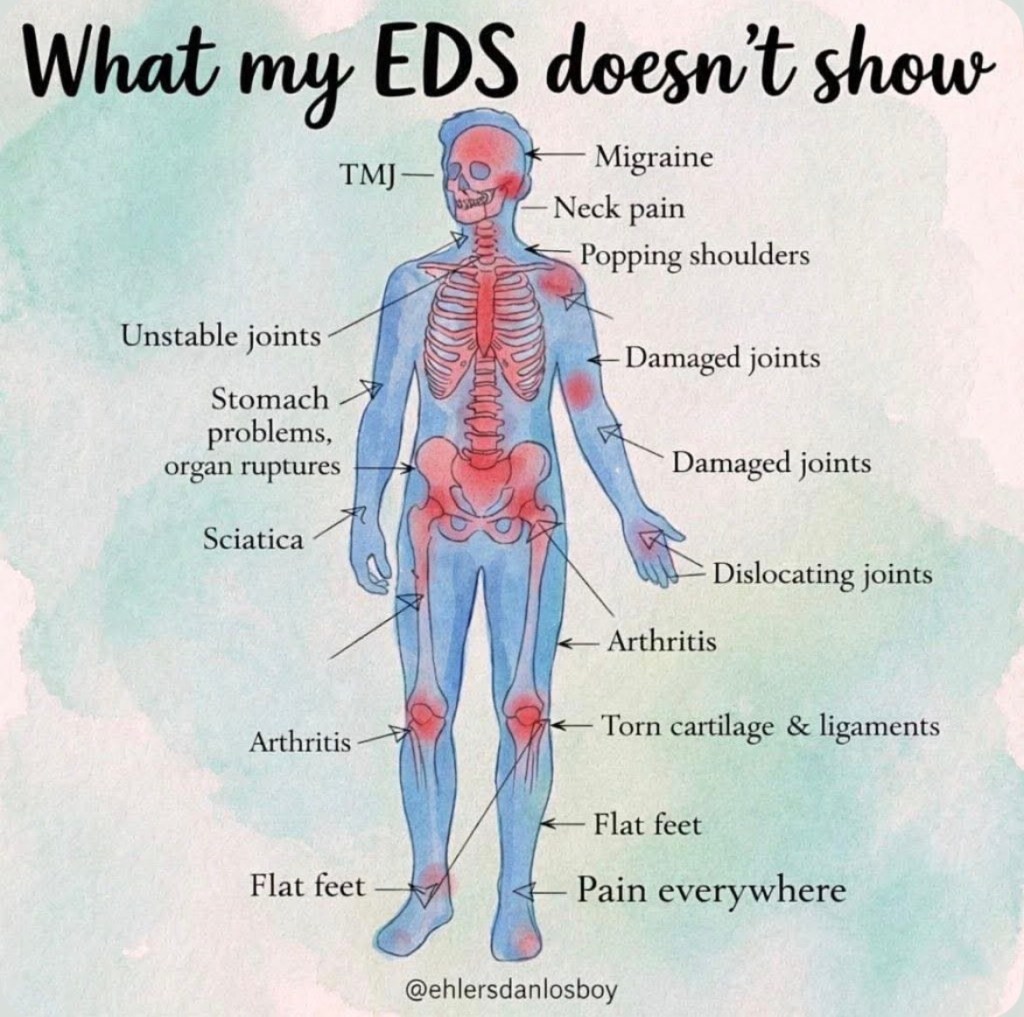
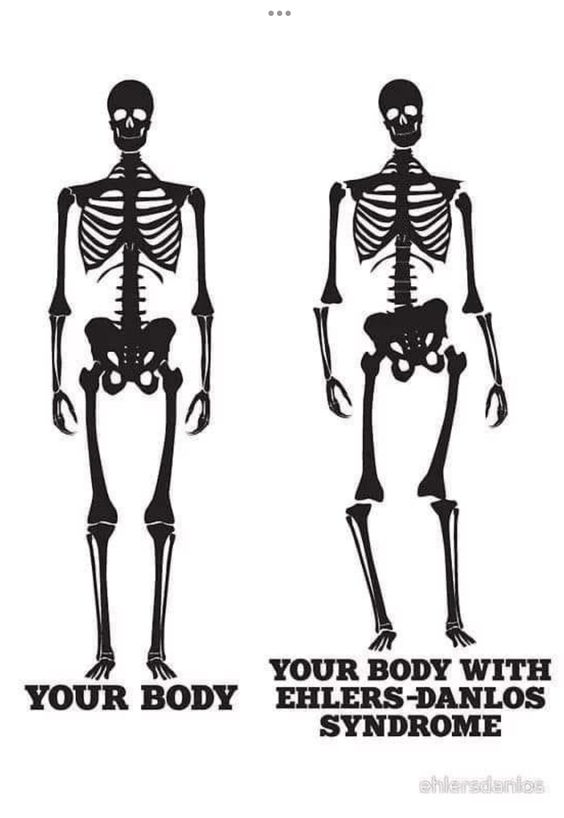
I mentioned I don’t have Ehler’s Danlos Syndrome (EDS) but something similar. I use their images because they apply to me.
I heard a fellow sufferer say once that their joints go out more than they do! I concur. My body does not like the evening, or the cold, or anything too loud or stimulating. It is a picky body. Staying in is the best plans for this lady!
But I can sing along with the song, I’m Flexy and I Know It. That’s the words, right?
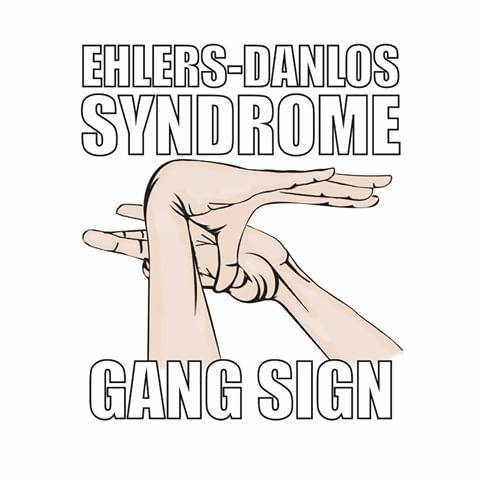
Sometimes a picture can say it all.
If you can do this you may have a connective tissue disorder. Who knew? I thought it was just a fun party trick to be able to contort my body for the amusement of friends.
The reason I do some explaining about my disorder is to hopefully connect with those who are suffering from some of the same issues. It can be difficult for generally healthy people to understand. With the best of intentions they will give you all the medical advice you never wanted. In most cases it won’t apply. General health advice will often not help those with chronic illness.
I am still healing. I have a ways to go. But to use the idea of Stephanie Spark, I want to walk through the flames of this hell with buckets of water ready to turn around and pour it on those still consumed by the fire.
To my fellow sufferers, do not doubt yourself. You are a warrior.
Our bodies are not made to deal with the level of toxins in our world. Add to that high levels of stress, lack of sleep, medications, surgeries, etc. So what can we do?
I have an answer for the healthiest to the most toxic ridden among us.
Forest therapy.
Going into any natural space is so beneficial. Ground. Meditate. Pay attention to your surroundings. Wrap up warm and breathe in the fresh, crisp air of fall.
When you are ready to practice forest therapy with a guide to get the greatest benefits, reach out and contact me. I can help you maximize the benefits you experience in the forest.
Live in each season as it passes; breathe the air, drink the drink, taste the fruit and resign yourself to the influence of the earth. – Henry David Thoreau