
SUNBEAM ACRES
In English, we say, “Winter is here.”
But in poetry we say,
“The earth has pulled a blanket tight.
Of frost and snow and winter white.
The trees are bare, the rivers slow,
Waiting for the spring to grow”
-fb/EnglishLiterature11
There is a difference between being determined and being determined to ignore your own body.
I know that distinction because I’ve spent a good portion of my life confusing the two.
I used to think that if I could just summon enough determination, I could get through whatever needed doing. A little more grit. A little more effort. A little less attention to how I was feeling.
After all, things need doing. People are counting on you. There are commitments to keep, responsibilities to manage, and a life you actually want to participate in.
So you push through.
And it works.
Until it doesn’t.
For those of us living with chronic conditions, here is a glimpse into what happens when we repeatedly override the signals our nervous system sends us.
Your nervous system is trying to tell you something

Your nervous system is constantly gathering information about your internal and external environment. It helps coordinate your responses to what is happening around you and within you.
It communicates through sensations and responses that we often dismiss as inconveniences.
Fatigue.
Resistance.
Anxiety.
Muscles tightening or bracing.
A sudden feeling of overwhelm.
That sense that you simply don’t have it in you today.
These aren’t necessarily signs of weakness, laziness or a lack of motivation. They are information.
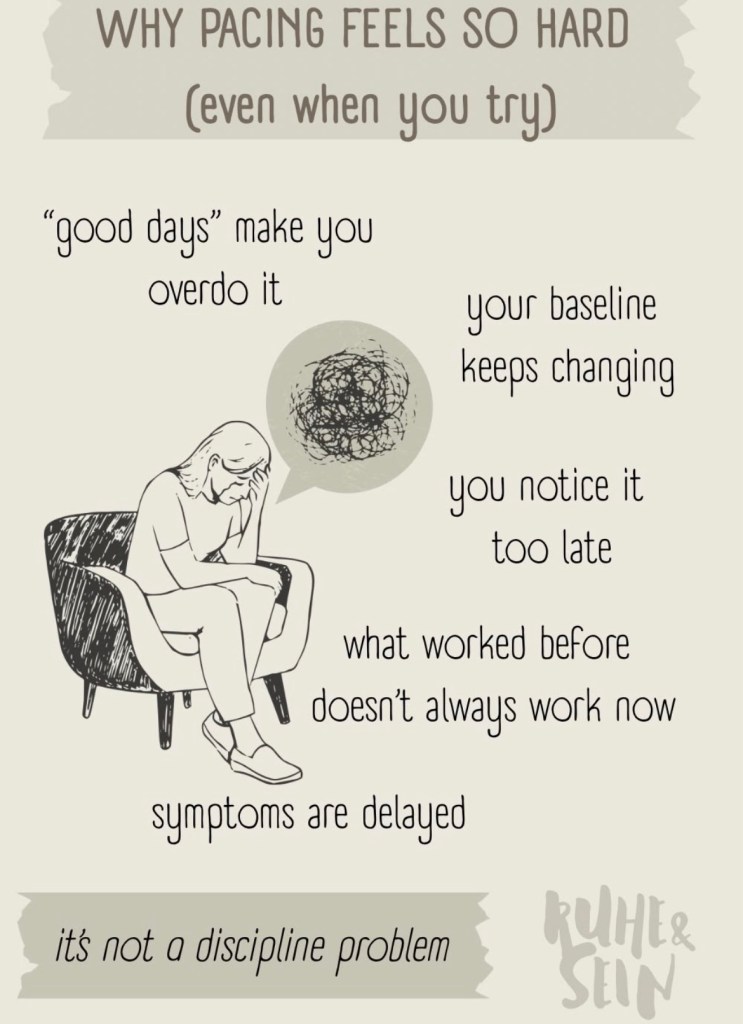
Sometimes the message is that you need rest. Sometimes you need to feel safer, slow down or regulate after too much stimulation. Sometimes a commitment feels overwhelming because you simply don’t have the resources available to meet it.
Your body is giving you information about its current state.
But what do we often do with that information?

We override it.
We tell ourselves we’re being ridiculous. We shouldn’t be this tired. We have no reason to feel anxious. We can rest later.
And then we get on with things.
The interesting part is that this strategy can work remarkably well in the short term.
You push through, accomplish the task, meet the commitment and produce the result.
Your determination is real. Your ability to tolerate discomfort can be impressive.
But there is a catch.
Your nervous system doesn’t necessarily interpret your ability to push through as evidence that everything is fine.
It may simply keep trying to get your attention.
From a Request to a Roar
I once had a doctor explain something to me.
It starts as a request, which becomes a demand, which becomes a roar.

If you keep ignoring it, eventually your body shuts down.
Think about that. You are not deciding between a tired day or a really tired day. You are deciding between a body that feels heard or one that feels hushed. It will respond accordingly.
You feel a little resistance before an outing. You ignore it.
You notice that you’re unusually tired after a busy day. You push through the next one.
Your muscles are tense, you’re becoming increasingly anxious, and even ordinary decisions seem to require more effort. But you have things to do, so you keep going.
The nervous system doesn’t have an unlimited supply of ways to communicate.
When its signals are repeatedly overridden, the experience can become increasingly difficult to ignore.
The occasional anxiety becomes a persistent feeling of being on edge.
The resistance becomes a constant struggle to get started.
The fatigue that once followed a busy day begins to feel like your everyday baseline.

And eventually, the body may respond by reducing what it can manage.
This isn’t your nervous system being dramatic.
It’s a protective system responding to what it perceives as an ongoing demand.
One important distinction here. Not every episode of fatigue or anxiety means your nervous system is heading toward shutdown. But repeatedly ignoring your limits can contribute to a pattern of worsening dysregulation and reduced capacity.
And for someone already living with chronic illness, that distinction matters enormously.
The body budget

Here’s where I think this conversation becomes particularly important for those of us with chronic conditions.
Many people can push through a demanding day and recover with a good night’s sleep or a quiet weekend.
Those of us living with chronic pain, fibromyalgia, ME/CFS, hypermobility and a host of other ongoing conditions, may not have that same flexibility.
Our starting point is different.

We may already be using a significant portion of our available energy just to get through ordinary daily activities.
Getting dressed. Preparing food. Having a conversation. Driving somewhere. Managing pain. Processing noise, light and other sensory input. Keeping our bodies upright and moving.
All of these things require resources.
I have heard it referred to as a daily body budget.
And some days, the budget is pretty small.
We don’t have a warehouse out back with extra supplies waiting to be delivered when we run out.
There isn’t a secret reserve that we can keep borrowing from indefinitely. Akin to a young person’s understanding of the abilities of an ATM.
When our available resources have been used, asking for more doesn’t necessarily produce more.
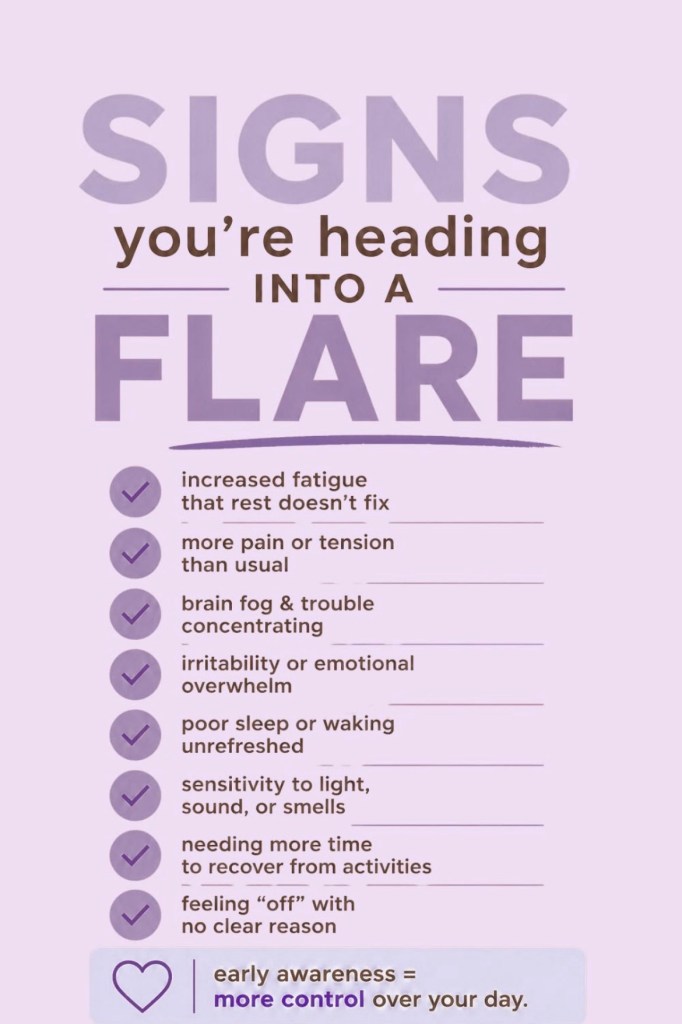
It can produce a flare. Increased pain. Sensory overload. Exhaustion. A significant loss of function.
Sometimes it means days of recovery from something that appeared relatively ordinary to everyone else.
This is why telling someone with chronic illness to simply push through can be such unhelpful advice.
We aren’t necessarily lacking determination. Most of us have that in spades ♠️.
We may have already spent everything we had.
And sometimes, the cost of borrowing against tomorrow is a tomorrow that becomes considerably harder.
Determination is not regulation
One of the most useful distinctions I’d like to offer is between willpower as an override and regulation as a strategy.
They are not the same thing.
Willpower says:
I feel the signal. It’s inconvenient. I’m going to do it anyway.
Regulation says:
I feel the signal. What is it telling me? What do I need to do before I ask my body for more?
Sometimes we genuinely do need to push through a little discomfort. Life isn’t always going to accommodate our preferred timing.
Sometimes babies are born and new siblings need their grandma.



Sometimes the lake is shining and the risk is worth the reward.




Sometimes the gym is an icy walk away and you can’t take the winter off.

But there is a difference between making an intentional decision to use our available resources and repeatedly pretending those resources don’t have limits.
Regulation means paying attention before we reach the point of exhaustion.
It means making adjustments. Taking breaks. Reducing stimulation. Allowing recovery. Sometimes changing the plan altogether.
It isn’t about becoming less ambitious or giving up on the things that matter.
It’s about learning to participate in life without continually sacrificing our ability to participate tomorrow.
For me, that has been a much bigger lesson than learning to be more determined.
I already know how to push. I’m learning when not to.
Replenishing the Body Budget
So what do we do instead?
This is where I think forest therapy has something valuable to offer.

Not as another activity to squeeze into an already full schedule. Not as another wellness task to accomplish.
But as an opportunity to give the nervous system a different kind of input.
When we spend time in a natural environment, engaging our senses without demanding anything from ourselves, we create opportunities for the body to settle.
We can slow our pace. Let our eyes wander. Listen to the wind, the birds or the quiet. Notice the texture of tree bark beneath our fingers. Feel the ground supporting us.
We move away from constant doing and toward simply being.
There is research behind this, too. Forest bathing ; Anxiety and HRV, Stress and Nature Based Interventions, Cardio and mental health responses to Shinrin-Yoku
Studies of forest environments have found changes in measures such as heart rate variability and parasympathetic activity, which are associated with the body’s ability to regulate and recover.
I particularly like that forest therapy doesn’t require us to achieve anything.
You can sit on a bench. Lean against a tree. Watch snow fall.

Shinshin
The quiet, almost spiritual sound of
falling snow. ❄️ ❄️ ❄️
You can even have a particularly successful forest therapy session without moving more than six feet from your car.
I’m a big fan of accessible achievements.
The goal isn’t to force your nervous system into relaxation. It’s to offer it an environment where settling becomes a little easier.
And over time, these small opportunities for recovery can become part of how we manage our available resources.
Saskatchewan Winter: Beautiful, But Slightly Inconvenient
And now, here we are.
Snow has arrived in Saskatchewan.
On the upside, everything looks prettier. Trees are wearing their winter coats, the landscape is quieter, and even an ordinary backyard can look like something from a Christmas card.

On the downside, getting our grounding and earthing time takes a little more planning.
Bare feet on frozen ground aren’t exactly appealing. Neither is risking a fall on an icy trail in the name of wellness. (I have enough experience with my body’s creative interpretations of the purpose of gravity.)
But winter doesn’t mean we have to disconnect from nature.
We can sit beside a tree, place our hands against its bark, touch the snow, or find a safe place to sit outdoors and engage our senses.
Grounding is about more than getting our bare feet onto the earth. It’s also about reconnecting with the natural world through intentional sensory experiences.
I’ve written more about making this work in our Saskatchewan winters in Why Winter Trails are Terrifying For the Hypermobile: Through Pain and Pines. It includes some practical ideas for staying connected to nature when the trails are less than cooperative.
We don’t need to turn recovery into another endurance event.
Listen Before the Roar
Before my mom reads this and worries about me, I am learning to listen before the roar. This post is about where I have been. Not where I currently am. And how I still need to be carefully cognizant to never return. To notice the back sliding.

Sometimes I find myself in the middle of a mess of my own making that I don’t have the spoons for. Other times, life circumstances get me in that same mess. But when I have the choice, I don’t need to prove how much I can tolerate. I will listen before the request becomes a demand. Definitely before the roar.
I want to get better at recognizing the requests, earlier.
The first signs of fatigue. The resistance. The tension. The little indications that my body is asking for something different.
I want to stop treating those signals as obstacles to overcome and start treating them as information worth considering.
Especially when living with chronic illness, our capacity is not something we can endlessly negotiate with.
Sometimes the most productive thing we can do is stop.
Sometimes the wisest decision is to change the plan.
And sometimes the best thing we can do for tomorrow is take care of today.
We cannot keep spending resources we don’t have and expect our bodies to simply find more.
So this week, perhaps try something different.
Listen for the whisper.

Give your body a little room to respond.
And if you can, go find a tree.
Pam Munkholm | Sunbeam Acres